
Checklist for Buying Eco-Friendly Gemstones

When purchasing gemstones, making eco-conscious choices supports ethical labor practices and reduces harm to nature. Here's a quick guide:
- Choose Lab-Created Gemstones: These are chemically identical to mined stones but avoid land damage and require less energy and water. Moissanite is a standout option - affordable, durable, and brilliant.
- Verify Ethical Certifications: Look for certifications like the Kimberley Process, Responsible Jewellery Council, or Fairtrade Gold to ensure conflict-free and fair labor sourcing.
- Check Production Methods: Ensure mining or lab processes minimize waste, protect habitats, and comply with safety standards.
- Evaluate Supplier Transparency: Ask for documentation tracing the gem's journey from source to sale. Beware of vague claims without proof.
- Opt for Recycled or Ethical Metals: Recycled gold and platinum reduce environmental strain. Confirm certifications like SCS Recycled Content or Fairmined Gold.
- Buy from Trusted Brands: Choose jewelers with clear supply chain details and ethical practices. Brands like Rokshok use lab-created moissanite and recycled metals.
- Ask About Maintenance Services: Regular cleaning and repairs extend jewelry lifespan, reducing waste.
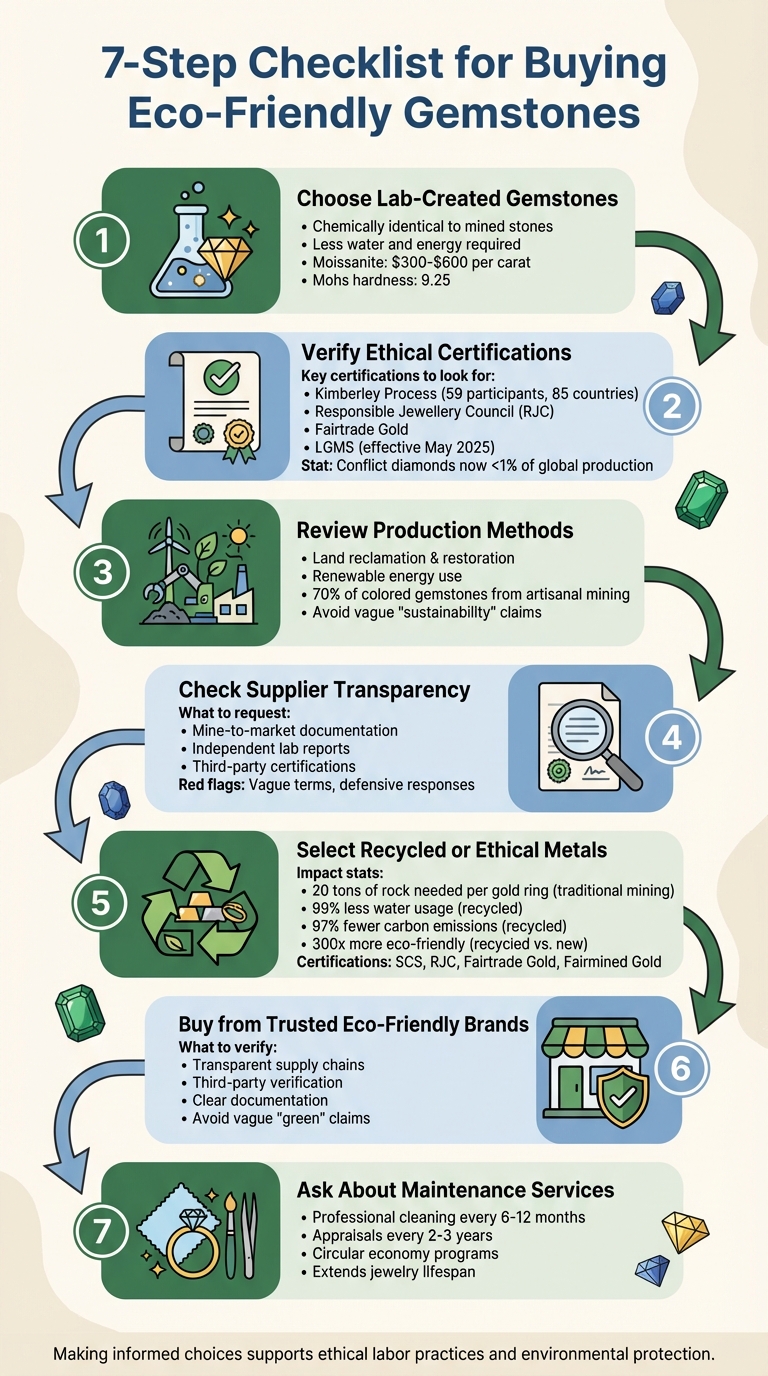
7-Step Checklist for Buying Eco-Friendly Gemstones
4 Sustainable, Eco-Friendly & Ethically Sourced Gemstones You Should Know About!
sbb-itb-1bb5b78
Step 1: Choose Lab-Created Gemstones
Lab-created gemstones provide a more eco-conscious alternative to mined stones. These gems are identical to natural ones in their chemical, physical, and optical properties. Using advanced techniques like HPHT (High Pressure High Temperature) or CVD (Chemical Vapor Deposition), scientists recreate the conditions under which gemstones naturally form.
How Lab-Created Gemstones Help the Environment
Mining for gemstones can wreak havoc on ecosystems - damaging land, polluting water, and generating massive waste. Lab-grown gemstones, on the other hand, require much less water and energy to produce. They avoid land disruption, preserve habitats, and eliminate mining-related waste. Facilities that rely on renewable energy further reduce their carbon footprint. Plus, every lab-created gemstone comes with complete supply chain transparency, guaranteeing it’s entirely conflict-free. In addition to lab-grown diamonds, moissanite is another excellent, eco-conscious option.
Why Moissanite Is a Great Sustainable Choice
Moissanite is one of the most environmentally friendly gemstones you can choose. Made from silicon carbide, it takes less energy to produce compared to lab-grown diamonds. With prices ranging from $300 to $600 per carat, it’s an affordable and dazzling option. Moissanite scores 9.25 on the Mohs scale for hardness, boasts a refractive index of 2.65–2.69, and has a dispersion of 0.104, giving it a stunning rainbow sparkle. Its durability and brilliance make it perfect for everyday wear. Brands like Rokshok offer moissanite jewelry that combines sustainable luxury with exquisite design.
Step 2: Verify Ethical Certifications
Once you've chosen lab-created gemstones, the next step is to confirm their ethical certifications. This ensures the gemstones are responsibly sourced, conflict-free, and align with fair labor practices and environmental guidelines.
Key Certifications to Look For
The Kimberley Process Certification Scheme (KPCS) has been in place since 2003 to prevent conflict diamonds from entering the market. As of January 2024, it includes 59 participants representing 85 countries. Back in 2006, the KPCS tracked $35.7 billion worth of rough diamond exports - over 480 million carats. Thanks to this initiative, conflict diamonds now account for less than 1% of global production.
The Responsible Jewellery Council (RJC) certification guarantees ethical practices across the entire supply chain, from mining to retail. Its Code of Practices addresses critical issues like human rights, labor conditions, and environmental impact. To confirm compliance, look for the RJC certification logo, which signifies that the jeweler has passed independent third-party audits.
Fairtrade Gold and Gemstones certifications ensure miners earn fair wages and work in safe environments. Programs like Moyo Gems in Africa demonstrate the impact of such initiatives, with miners earning three to ten times more than those outside these programs.
For lab-grown stones, the Laboratory Grown Materials Standard (LGMS) will take effect in May 2025. This certification sets ethical and environmental criteria for lab-created gemstones, with mandatory audits beginning in May 2026.
Ensuring Transparency Through Certifications
Ethical certifications require thorough documentation at every stage of a gemstone's journey. For diamonds, your invoice should include a statement like this:
"The diamonds herein invoiced have been purchased from legitimate sources not involved in funding conflict and in compliance with United Nations resolutions." - World Diamond Council System of Warranties
You can also request mine-to-market provenance documents, which detail the exact mine location and every intermediary involved. The 2024 updates to the RJC standards now require stricter "Know Your Customer" procedures to trace materials back to their origin. Some suppliers even leverage blockchain technology to create an unchangeable digital record of a gemstone's entire history. If a seller cannot provide clear origin details, the gemstone cannot be confirmed as ethical - regardless of marketing claims.
Step 3: Review Production Methods
Once you've checked certifications, it's time to take a closer look at how your gemstones are produced. Whether gemstones are mined or lab-created, the production method plays a key role in determining the environmental impact. This step works hand-in-hand with certification checks to ensure the processes used are aligned with efforts to reduce environmental harm.
Responsible Mining and Lab Production Methods
For mined gemstones, responsible mining practices focus on land reclamation and restoration. This involves rehabilitating the land after mining, often through reforestation or returning the area to its natural state. Look for mines that adhere to legal reclamation standards and take specific actions to restore ecosystems. Additionally, responsible mining operations safeguard local water sources from contamination and have effective waste management systems to prevent environmental damage.
Small-scale artisanal mining offers another approach, often causing less environmental disruption compared to large-scale industrial mining. About 70% of the world’s colored gemstones come from artisanal mining, which relies on manual labor and small tools rather than heavy machinery. This method generally avoids the deforestation and soil erosion commonly associated with large-scale mining - an issue especially prevalent in the diamond industry, which dominates around 85% of the global gemstone market.
When it comes to lab-grown gemstones, focus on the facility's energy usage and chemical management. Verify that the lab operates on renewable energy and follows strict protocols for handling chemicals and waste. Cutting-edge technologies like laser cutting and computer-aided design (CAD) are often used to reduce material waste and eliminate the need for harmful chemicals during production.
Be cautious of vague "sustainability" claims. Simply labeling gemstones as sustainable can be misleading, as the extraction of non-renewable resources is inherently unsustainable. Instead, prioritize evidence-based practices such as land restoration, renewable energy use, and transparent waste management. These are the practices that genuinely help reduce environmental impact. In the next step, we'll explore supplier transparency to ensure these production methods can be traced back to their source.
Step 4: Check Supplier Transparency
Once you've nailed down the production methods, it's time to evaluate supplier transparency. This step is crucial for ensuring ethical sourcing. A trustworthy supplier will openly share detailed information about the gemstone's origin and production process - steering clear of vague or misleading marketing jargon.
Start by asking direct questions like: "Where does this gemstone come from?" and request mine-to-market documentation. This chain-of-custody record traces the stone's journey from the miner, through the cutter, and finally to the dealer.
You should also ask for independent lab reports and third-party certifications. Always take the extra step to verify these certifications through official databases.
Be alert for warning signs that might indicate a lack of credibility. For instance, suppliers who use ambiguous terms like "eco-friendly" or "natural" without concrete evidence, or those offering "ethical" gemstones at prices that seem too good to be true, should raise concerns. Maya Thompson offers this advice:
"A transparent jeweler will welcome your questions. If they get defensive or vague, consider it a giant, flashing red light."
Remember, the presence of multiple intermediaries can sometimes obscure a gemstone's true origins. Transparency isn’t just about the mining process; it also includes details about cutting, polishing, and labor practices. If a seller can’t provide this level of detail, it’s a strong indicator that their ethical claims might not hold up. As Courtney MacDougall of Gem Breakfast explains:
"If a seller can't tell you where a gemstone came from or how it was sourced, it isn't truly ethical - no matter how it's marketed."
Step 5: Select Recycled or Ethical Metals
When crafting a sustainable piece of jewelry, the metal holding your gemstone is just as important as the gem itself. Traditional gold mining is incredibly resource-intensive - producing a single ring can require extracting around 20 tons of rock and soil. By opting for recycled or ethically sourced metals, you make a choice that aligns with responsible sourcing and production values.
Recycled metals completely bypass the need for new mining. Whether sourced from old jewelry, industrial scrap, or electronic waste, recycled gold, silver, and platinum are chemically identical to newly mined metals. They offer the same shine and durability but with a fraction of the environmental toll. Maya Thompson from Robinson's Jewelers highlights this advantage:
"The beauty of recycled metals? They require no new mining whatsoever. The environmental impact is dramatically lower – we're talking up to 99% less water usage and 97% fewer carbon emissions compared to newly mined metals."
Refining recycled gold is up to 300 times more eco-friendly than processing newly mined gold when considering energy use and climate impact. For instance, Pandora’s commitment to using 100% recycled silver and gold helps cut an estimated 58,000 tons of CO₂ emissions annually. Similarly, Chopard has transitioned to using 100% ethical gold across its product lines as of October 2025. This approach ensures that ethical practices extend from gemstone sourcing to the very metal settings that complete your jewelry.
Using Recycled Metals in Jewelry
To ensure your jewelry truly reflects sustainable values, look for independent certifications when purchasing recycled metals. The SCS Recycled Content Certification guarantees that the metals used are 100% recycled. Similarly, the Responsible Jewellery Council (RJC) Chain of Custody certification ensures ethical and environmental standards are upheld throughout the supply chain. For ethically sourced metals, labels like Fairtrade Gold and Fairmined Gold confirm that artisanal miners are paid fair wages, work under safe conditions, and avoid child or forced labor.
When shopping, ask your jeweler pointed questions, such as: "What percentage of the metals in this piece are recycled?" or "Can you provide documentation for the origin of these materials?" Reputable brands should be able to provide chain-of-custody documentation or sustainability reports. Transparency is as critical for metal sourcing as it is for gemstones. Be cautious of vague terms like "eco-gold" unless backed by third-party verification - lack of concrete proof can be a red flag.
For a durable and sustainable choice, consider solid recycled gold or platinum instead of plated options. While solid metals may cost more initially, they avoid the need for frequent replating and are easier to repair or recycle in the future, making them a smarter long-term investment.
Step 6: Buy from Trusted Eco-Friendly Brands
Once you've evaluated certifications and production methods, the next step is finding a brand that genuinely upholds eco-friendly values. It's important to choose jewelers who can back up their claims with solid, verifiable information. Look for companies that are transparent about their supply chains and provide clear documentation on their environmental and labor practices. Be cautious of vague terms like "green" or "sustainable" unless they come with third-party verification or detailed proof.
Why Rokshok Prioritizes Eco-Friendly Practices

Rokshok, founded in 2015, has built its reputation on offering sustainable luxury. The brand exclusively uses lab-created moissanite, a choice that avoids the environmental damage and habitat destruction tied to traditional gemstone mining. Additionally, this approach ensures conflict-free sourcing. Rokshok collaborates with Charles & Colvard, leaders in ethical moissanite production, to deliver stones that meet high durability standards.
Rokshok goes beyond sourcing responsibly. They offer custom design services using advanced CAD technology, allowing customers to create jewelry that aligns with their personal style and ethical values. To further promote sustainability, the brand provides professional cleaning and maintenance services, helping extend the lifespan of their pieces. This way, they make sustainable luxury accessible without sacrificing quality or brilliance.
Step 7: Ask About Maintenance Services
Before sealing the deal on your jewelry, make sure to ask the jeweler about their professional cleaning and maintenance services. Keeping your jewelry in good condition is part of a bigger picture - your commitment to eco-friendly practices doesn't stop at sourcing; it extends to how you care for your pieces. Regular maintenance not only keeps your jewelry looking great but also helps it last longer, ultimately reducing waste. Experts recommend professional cleanings every 6 to 12 months to get rid of dirt and grime that at-home methods might miss. Plus, these visits give jewelers a chance to check for issues like loose prongs or weak clasps, which could lead to bigger problems down the line.
When it comes to cleaning, jewelers use tools designed for specific gemstones to ensure they’re cleaned safely. For instance, ultrasonic cleaners - though effective - can harm porous stones like opals or pearls. On the other hand, harder gems like moissanite, sapphires, or diamonds can benefit from professional polishing, which removes scratches and restores their shine.
"Repairs preserve functionality and beauty, extending piece longevity and reducing need for replacements." - Gemstone.Top
Many jewelers also offer circular economy programs, such as take-back, upgrade, or refurbishing services. These programs help extend the life of materials and reduce waste. Additionally, ongoing inspections can catch small issues - like thinning prongs or tiny cracks - before they turn into major damage, such as losing a stone or breaking the piece completely. Scheduling professional appraisals every 2 to 3 years is another smart move. This not only documents the condition and value of your gemstone but also helps with insurance and long-term care planning.
For eco-friendly stones like moissanite, maintenance is relatively simple. You can soak your moissanite in warm water mixed with a few drops of pH-neutral dish soap for 15–30 minutes. Gently scrub it with a soft-bristled toothbrush, rinse with distilled water if needed, and dry it with a lint-free microfiber cloth. Just steer clear of harsh chemicals like bleach, ammonia, or vinegar, as they can damage the metal settings and shorten your jewelry’s lifespan.
Conclusion
Buying gemstones with an eco-conscious mindset allows you to align your purchases with your values. By using a clear checklist, you can navigate past vague marketing claims and ensure your jewelry choices genuinely support environmental care and ethical labor practices.
When you ask for proper documentation, confirm certifications, and select brands that prioritize openness, you're doing more than avoiding misleading claims - you’re helping to create real change within the industry. Every purchase you make strengthens the push for ethical sourcing. Opting for lab-grown gems like moissanite, using recycled metals, or supporting brands with transparent supply chains contributes to a positive shift that benefits both mining communities and the environment.
The gemstone industry is adapting, with advancements like blockchain technology for traceability and circular economy initiatives gaining traction. By sticking to the steps in the checklist, your choices can actively encourage the industry's progress toward more ethical and sustainable practices - all while complementing your personal style.
FAQs
How can I confirm a gem is truly ethical?
To ensure a gemstone aligns with ethical practices, start by confirming it comes from a source that prioritizes transparency and responsibility. Certifications such as those from the Responsible Jewelry Council or Fairtrade Gold are good indicators, as they verify ethical sourcing and responsible practices.
Don't hesitate to ask the seller for specifics about the gem's origin and supply chain. If you're looking for an alternative to mined gemstones, consider lab-grown options like moissanite. These offer an eco-conscious and ethical choice without compromising on beauty or quality.
What’s the easiest way to spot greenwashing?
To identify greenwashing in so-called eco-friendly gemstones, focus on clear transparency and check for verified certifications, such as those from the Responsible Jewelry Council or Fairtrade Gold. Be cautious of generic claims like "sustainable" that lack specific details about sourcing. Ethical companies typically share traceable information about a gemstone’s origin, including its environmental and social impact. If this kind of detail is absent or vague, it may indicate greenwashing.
Do eco-friendly gems cost more long-term?
Eco-friendly gemstones might come with a higher price tag initially because of their ethical sourcing and sustainable production methods. But in the long run, they can be a smarter investment. Choosing these gems helps support ethical practices and minimizes environmental damage. Plus, they align with the growing focus on responsible consumption and sustainability.
