
Checklist for Evaluating Moissanite Sparkle

Moissanite is celebrated for its intense sparkle, surpassing diamonds in both fire (colorful light dispersion) and brilliance (white light reflection). But not all moissanite stones sparkle equally. Here's how to evaluate their quality:
- Cut Quality: The cut determines how light interacts with the stone. Look for precise facet symmetry, avoid shallow or deep cuts, and prioritize brilliant cuts like Round or Radiant for maximum sparkle.
- Color Grade: Choose between D-F (colorless) for an icy look or G-I (near-colorless) for a subtle warmth. Match the grade with the metal setting for the best appearance.
- Clarity: Aim for FL to VS1 grades. Most moissanite is eye-clean, but inclusions in lower grades can dull its sparkle.
- Lighting Performance: Test brilliance (white light) in direct light and fire (rainbow flashes) in soft or low light to see how the stone performs in various environments.
- Certification: Verify the stone with a lab certificate from trusted organizations like GIA or IGI. Ensure the seller is reputable and provides clear documentation.
Evaluating these factors will help you select a stone that delivers the dazzling sparkle moissanite is known for.
Moissanite Buyer's Guide
sbb-itb-1bb5b78
Step 1: Check the Cut Quality
When it comes to moissanite, the cut is everything. Sure, color and clarity play their roles, but the cut determines how light interacts with the stone - how it enters, reflects, and exits. A well-executed cut creates those sharp, brilliant flashes of light, while a poorly executed one (too shallow or too deep) lets light leak out, leaving the stone looking dull and lifeless.
"Most jewelers will tell you that cut is the single most important factor in a stone's beauty... the cut is what truly unlocks a gemstone's potential." - Shera Jewelry
The cut also influences three major aspects of light performance: brilliance (white sparkle), fire (colorful flashes), and scintillation (sparkle when the stone moves). Since moissanite is doubly refractive, its facet angles and patterns demand extra attention. If not cut properly, you risk getting a distracting "disco-ball" effect or seeing doubled facets. Let’s break down how to assess the precision of a moissanite’s cut.
Check Facet Precision and Symmetry
Start by examining the stone under 10x magnification. Look for clean, sharp junctions where the facet edges meet. Precision and symmetry are telltale signs of quality craftsmanship. Pay close attention to the center of the stone - issues like "windowing" (a see-through look) or a dark "nailhead" effect are red flags that the cut proportions are off. For round moissanite, aim for a depth of 60%–65% and a table percentage between 55%–58%.
Choose Brilliant Cuts
Brilliant cuts, like Round and Radiant, are designed to bring out moissanite’s natural sparkle. Round Brilliants typically feature 57–58 facets, while Radiant cuts can have over 70 facets. These cuts reflect about 95% of the light that hits them, making them far more dazzling than step cuts like Emerald or Asscher, which reflect closer to 80%. Step cuts, with their long, parallel facets, create a subtle "hall-of-mirrors" effect that highlights clarity rather than fire. However, they also expose around 30% more inclusions due to their open design. For maximum sparkle, stick with brilliant cuts.
Compare Multiple Stones Side by Side
Place several stones side by side under consistent lighting conditions - natural sunlight, LED, and dim light work well. This helps you see which stone has the most even brightness without any "dead" spots. Tilt each stone to check for uniform color distribution; a well-cut moissanite will show consistent scintillation rather than random, chaotic flashes. Always look for stones graded "Excellent" in cut, polish, and symmetry to ensure top-tier light performance.
Step 2: Check the Color Grade
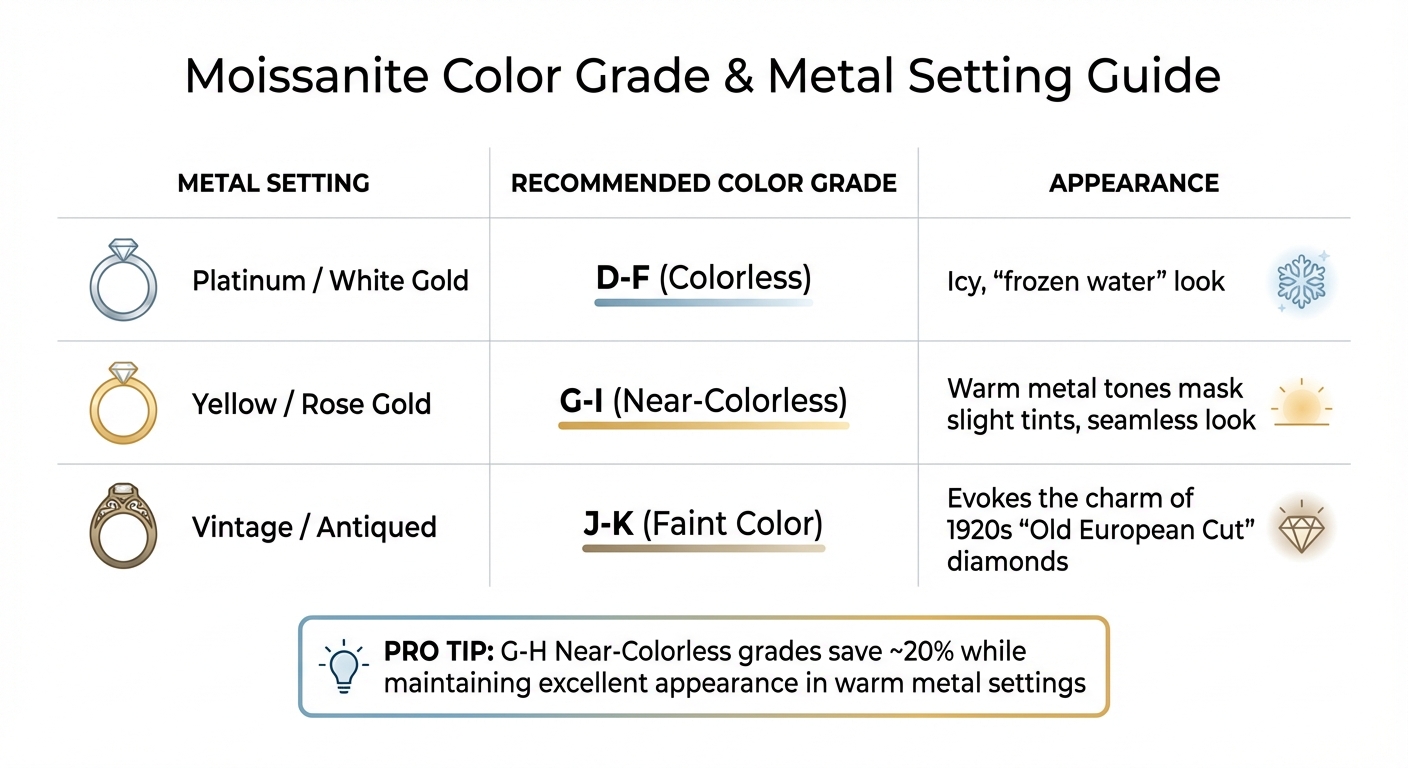
Moissanite Color Grades and Metal Setting Pairing Guide
When it comes to moissanite, color plays a big part in how its sparkle and fire are perceived. It directly impacts the stone's overall brilliance and appearance.
The color grade determines whether a moissanite appears icy-white or has a slight warmth. The grading scale ranges from D (completely colorless) to Z (noticeable color). However, most high-quality moissanite falls into two main categories: D-F (Colorless) and G-I (Near-Colorless). Colorless stones (D-F) have no detectable tint, creating a crisp, "frozen water" effect. On the other hand, near-colorless stones (G-I) have a barely noticeable warmth that can actually enhance the stone's fire.
For larger stones (3 carats or more), the size tends to trap more color, so choosing D-E grades is often recommended to avoid visible tints. For smaller stones (under 1 carat), these color differences are almost impossible to detect, making it a better investment to focus on cut quality instead.
Look for Colorless or Near-Colorless Grades
Your choice of color grade should align with your setting and the look you're going for. Interestingly, many experts now suggest opting for G-H near-colorless grades as a savvy choice. This trend, referred to as the 2026 "Pro Move", is explained by Mehedi Hasan, Founder of Moissanite by Aurelia:
"The 2026 'Pro Move' is actually to select a G-H Near-Colorless grade. This slight warmth mimics the organic look of a rare natural diamond while saving you roughly 20% on the price."
The metal setting also plays a critical role in how the stone's color is perceived. Here’s a quick guide:
| Metal Setting | Recommended Color Grade | Appearance |
|---|---|---|
| Platinum / White Gold | D‑F (Colorless) | Icy, "frozen water" look |
| Yellow / Rose Gold | G‑I (Near‑Colorless) | Warm metal tones mask slight tints, seamless look |
| Vintage / Antiqued | J‑K (Faint Color) | Evokes the charm of 1920s "Old European Cut" diamonds |
D-F stones are perfect for platinum or white gold, as their cool tones highlight the icy brilliance. Meanwhile, near-colorless stones (G-I) pair beautifully with yellow or rose gold, as the warm metal tones mask any slight tint, making the stone appear completely colorless while also saving you money.
Test in Different Lighting
Always evaluate moissanite under various lighting conditions to see how its color and fire behave. Natural daylight is ideal for mimicking everyday wear, but you should also check the stone under bright indoor bulbs or studio lighting. D-F stones often appear cooler and icier in photos, while G-H stones tend to show a softer rainbow fire. To make the most accurate assessment, compare multiple stones side by side under the same lighting. Subtle differences in color are much easier to spot this way.
Once you're confident in the color, the next step is to assess clarity for a complete evaluation.
Step 3: Review the Clarity Grade
After evaluating the cut and color, the next step is to assess the clarity of your moissanite. Clarity refers to the presence of internal inclusions that can interfere with light refraction, ultimately affecting the stone's sparkle. As Perimade & Co. explains, "A moissanite with a low degree of purity contains numerous inclusions, which directly affect the brilliance. Since inclusions hinder the refraction and return of light, the lower the degree of purity, the more opaque the moissanite will appear."
The upside? Roughly 99% of moissanites are considered "eye-clean", meaning their inclusions are invisible to the naked eye. This makes moissanite a standout choice compared to most diamonds. Still, reviewing clarity is essential to fully unlock the stone's potential for brilliance.
For the best results, aim for clarity grades between FL (Flawless) and VS1. If you're looking at a larger stone - 1.5 carats or more - opt for VVS1 or VVS2 grades, as inclusions are more noticeable with larger facets. On the other hand, avoid stones in the I1 to I3 range, as visible imperfections can significantly dull the sparkle and may even compromise the stone's structure.
Look for Inclusions Under Magnification
Clarity is typically assessed using 10× magnification, the industry standard. Before examining, clean the stone to remove any surface oils or debris that might obscure your view.
Here are the most common types of inclusions you might encounter:
| Inclusion Type | Description | Effect on Sparkle |
|---|---|---|
| Needles | Thin, white or translucent needle-like structures | These are the most common and generally only affect appearance when densely clustered. |
| Clouds | Hazy spots made up of tiny pinpoint clusters | They can give the stone a "milky" look, reducing transparency and fire. |
| Feathers | Small internal fractures | These can weaken the stone's structure and disrupt light refraction. |
| Cavities | Surface openings or shallow gouges | They can collect dirt and oil over time, leading to visible dark spots. |
"If something takes away from the beauty of the stone, we will not accept it." - Hannah Lee, moissanite grader at Perimade & Co.
This step ensures the stone's clarity aligns with your expectations for brilliance and sparkle.
Verify a Clean Appearance
Stones with fewer inclusions allow more light to pass through, enhancing both brilliance and fire. When comparing stones, use uniform lighting to spot subtle clarity differences. It's worth noting that even a single clarity grade shift can impact the price by several hundred dollars.
For most buyers, clarity grades between VVS1 and VS2 hit the sweet spot. These stones are eye-clean and deliver stunning sparkle without the higher price tag of flawless grades. Once you're satisfied with the clarity, you can move on to testing the stone's performance under various lighting conditions.
Step 4: Test Brilliance and Fire in Different Lighting
After ensuring the clarity of the stone meets your expectations, the next step is to evaluate how it performs with light. This involves checking how the stone interacts with different lighting conditions, giving you a sense of how it will look in everyday scenarios. Moissanite is known for its exceptional ability to reflect and disperse light, thanks to its high refractive index and dispersion. Testing it under various lighting setups will help you see its true potential.
Check Brilliance in Direct Light
Brilliance refers to the white light reflected by the stone. To assess this, place the moissanite under direct sunlight or a bright LED desk lamp. A well-cut moissanite should appear intensely bright and full of life, with noticeable internal reflections. For a more detailed inspection, use a 10× loupe. Tilting the stone under the loupe can reveal doubled facet junctions, a hallmark of moissanite's double refraction - especially evident in stones 1.0 carat or larger.
Check Fire in Diffused or Low Light
Fire refers to the colorful flashes of light that moissanite is famous for. To evaluate this, move to a space with soft, diffused lighting or use a single incandescent bulb. Slowly tilt and rotate the stone while observing it. A high-quality moissanite will display vibrant, rainbow-like flashes, even in dim light.
"Moissanite catches light even in low-light settings. It moves. It dances."
- Melissa Tyson, Founder, Melissa Tyson Designs
Unlike diamonds, which often have a more subtle glow in low light, moissanite remains bold and dynamic. If you notice dull white reflections or a flat appearance, it could indicate a poorly cut stone or lower-quality material. This step is critical before moving on to compare stones directly.
Compare Stones in the Same Lighting
Lighting can significantly influence how a gemstone looks. Studio lighting, for instance, might amplify sparkle, while natural light can soften it. To get a true sense of the stone's quality, compare multiple stones under the same lighting conditions, such as a single desk lamp or an incandescent bulb. This helps you focus on the impact of the cut on its light performance.
"A 1.2 ct moissanite will typically display broader, more colorful fire than a 1.2 ct diamond of similar cut under warm lighting."
- G S Sachin, Gemologist, Jewellers Reviews
Whenever possible, view the stones in person or through unedited video in different environments - natural light, indoor light, and spot lighting. This will give you a complete picture of how the sparkle holds up during daily wear.
Step 5: Check Certification and Documentation
Once you've evaluated the cut, color, and clarity of the moissanite, it's time to confirm its legitimacy and the seller's reliability. This final step ensures you're getting an authentic stone by examining its certification and verifying the seller's credentials. Proper documentation is essential to avoid counterfeits and confirm the stone's quality.
Confirm Lab Certifications
Authentic moissanite should come with a certificate from a recognized gemological laboratory. Trusted organizations like the Gemological Institute of America (GIA) and the International Gemological Institute (IGI) issue certificates verifying authenticity. The Global Gemological Research Academy (GRA) is another common certifier, particularly for high-grade stones like D Color VVS1. However, be cautious - counterfeit GRA reports do exist.
The certificate should include key details such as the stone's cut, color, clarity, and measurements. To ensure accuracy, examine the stone's girdle under 10× magnification and check for a micro-laser inscription that matches the certificate's ID. Most reputable labs also provide online databases where you can cross-check the certificate number and the stone's specifications.
"The paper alone is insufficient; verification of the physical stone is mandatory."
- Moissanite Experts
If the inscription is missing, the online database shows no match, or the stone's appearance doesn't align with the certificate (e.g., a supposed "D Color" stone showing yellow hues), these are warning signs. For additional confirmation, consider using an electronic moissanite tester. This device measures electrical conductivity to differentiate moissanite from other stones like cubic zirconia or sapphire.
After verifying the certification, the next step is to scrutinize the seller's credentials.
Review Seller Credentials and Photos
Since certificates can be forged, purchasing from a trustworthy seller is critical. Look for vendors that provide a "stone-to-paper" guarantee, ensuring the stone, its certificate, and the laser inscription all match. For example, Rokshok specializes in premium moissanite jewelry and offers detailed product photos from various angles, allowing you to inspect the stone before committing to a purchase.
Request high-resolution images or videos of the actual stone rather than relying on generic stock photos. Additionally, check customer reviews to gauge the seller's reputation and confirm they provide responsive customer support. These steps help ensure a secure and confident purchase.
Conclusion
Let’s wrap up by revisiting the key points for evaluating moissanite sparkle. Four main factors - cut quality, color, clarity, and lighting performance - play a big role in how well the stone showcases its brilliance and fire. A well-executed cut ensures light reflects and refracts beautifully within the stone, enhancing its brilliance. On the other hand, a poorly cut stone can allow light to escape, making it look dull. Color grading is equally important, helping you choose between a colorless or near-colorless appearance based on your personal style.
Don’t forget to test the stone under different lighting conditions. Moissanite’s high refractive index creates intense rainbow flashes, known as "fire", which truly stand out in both direct and diffused lighting. This fiery brilliance is one of moissanite's most striking features, so take the time to observe it thoroughly before making your choice.
Lastly, ensure you’re buying from a reputable source. Trusted retailers like Rokshok specialize in premium, eco-conscious moissanite jewelry. Their lab-created stones are ethically sourced, sidestepping the environmental and ethical issues tied to traditional mining. With custom design options using advanced CAD technology, along with cleaning and maintenance services, they provide not just high-quality gems but also a personalized experience.
FAQs
How can I tell if a moissanite cut is leaking light?
To spot light leakage in a moissanite cut, pay close attention to its sparkle and brilliance. If the stone looks dull or has noticeable dark areas, it could mean the cut isn't reflecting light effectively. Check the gemstone under different lighting conditions - a well-cut moissanite will exhibit lively brilliance and fire, free of dull spots or dark patches, ensuring it shines at its best.
Which moissanite color grade looks best in my metal setting?
The perfect moissanite color grade really comes down to what you prefer and the overall look you're aiming for. If you're after a timeless, completely clear appearance, D to F grades are an excellent choice, as they are colorless and elegant. On the other hand, G to I grades are near-colorless and still sparkle beautifully, especially in most settings. To get the best results, match the color grade to the tone and style of your metal setting to create the aesthetic you want.
How do I verify a moissanite certificate is real?
To ensure a moissanite certificate is genuine, start by looking for a micro-laser inscription on the stone, a common feature for GRA-certified moissanite. Next, head to the certifying organization's official website and use the certificate's serial number to confirm its authenticity. Be vigilant about counterfeit certificates and carefully compare the stone with the details listed in the certificate to make sure they align.
