
Moissanite Clarity Scale Explained

When choosing moissanite, clarity matters because it impacts brilliance and sparkle. Clarity refers to internal inclusions and surface blemishes that affect how light passes through the stone. Most moissanite is lab-created, meaning fewer imperfections compared to natural gemstones. Clarity is graded from Flawless (FL) to Included (I), with most moissanite falling into "eye-clean" categories (imperfections invisible to the naked eye). Here's a quick breakdown:
- FL/IF (Flawless/Internally Flawless): No visible inclusions or blemishes, rare and costly.
- VVS (Very, Very Slightly Included): Tiny inclusions, nearly undetectable, offering a near-perfect look.
- VS (Very Slightly Included): Minor inclusions, "eye-clean", balancing quality and price.
- SI (Slightly Included): Noticeable inclusions under magnification, sometimes visible to the eye.
- I (Included): Visible inclusions that may reduce brilliance and durability.
For most buyers, VS or VVS stones are ideal for their balance of clarity and cost. Round cuts hide inclusions better, while open cuts like Emerald benefit from higher clarity. Lab-grown moissanite ensures high clarity and is a more ethical and affordable alternative to diamonds.
“Eye Clean” Moissanite & Diamond Stones? What does that mean?
sbb-itb-1bb5b78
The Moissanite Clarity Grading System
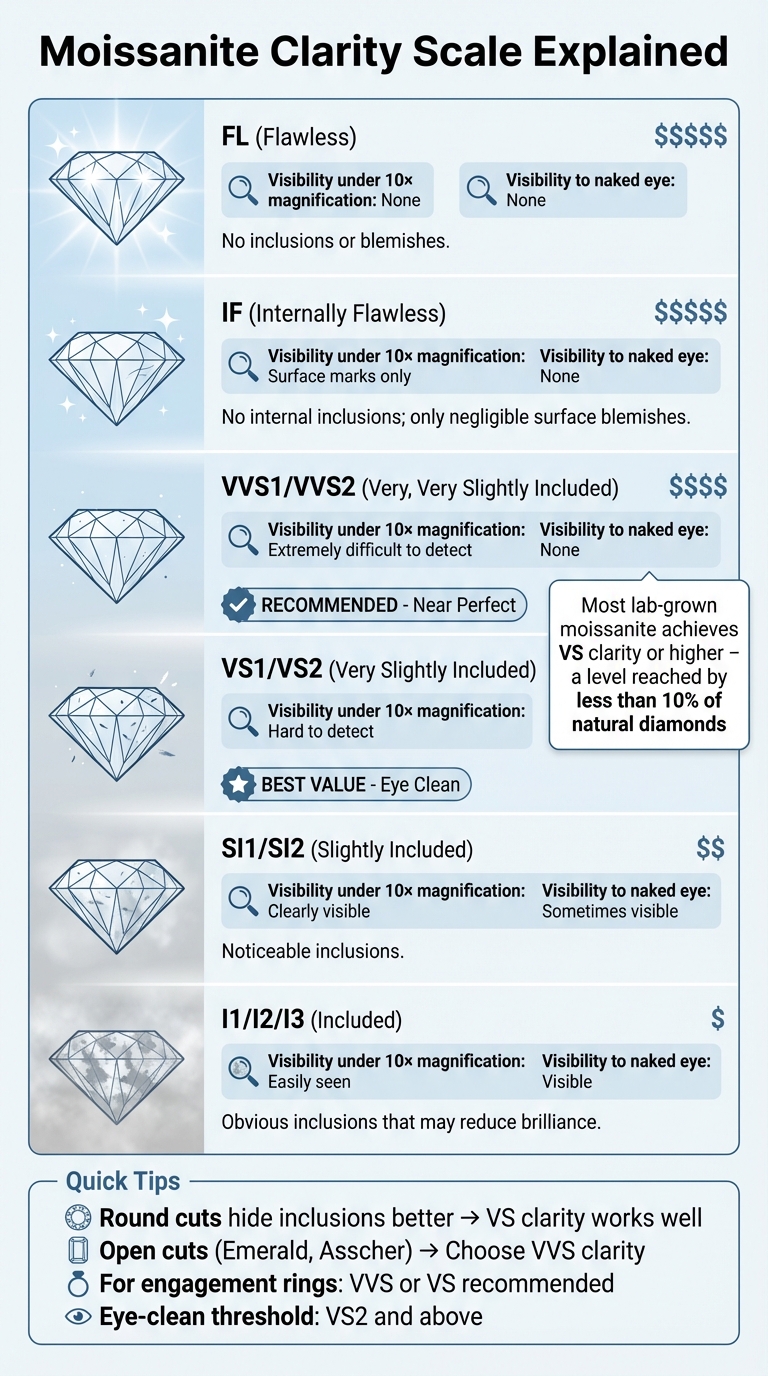
Moissanite Clarity Grading Scale: Visual Guide to FL Through I Grades
Moissanite clarity is evaluated using a system inspired by the GIA's approach, focusing on inclusions and blemishes under 10× magnification. This system categorizes stones from Flawless (FL) to Included (I) to help buyers understand the quality of a moissanite stone.
Gemologists assess clarity by examining the type, size, amount, location, and visibility of inclusions.
Because moissanite is lab-grown, it usually contains fewer inclusions compared to natural diamonds. Most moissanite stones fall into the "eye-clean" category, meaning their imperfections are invisible to the naked eye. Interestingly, moissanite clarity often aligns with the "Very Slightly Included" (VS) grade on the GIA scale - a level achieved by less than 10% of faceted diamonds. This high clarity contributes to moissanite's brilliance and overall value.
| Clarity Grade | Description | Visibility Under 10× Magnification | Visibility to Naked Eye |
|---|---|---|---|
| FL (Flawless) | No inclusions or blemishes | None | None |
| IF (Internally Flawless) | No internal inclusions; only negligible surface blemishes | Surface marks only | None |
| VVS1 / VVS2 | Very, Very Slightly Included; minute inclusions | Extremely difficult to detect | None |
| VS1 / VS2 | Very Slightly Included; minor inclusions | Hard to detect | Generally "eye-clean" |
| SI1 / SI2 | Slightly Included; noticeable inclusions | Clearly visible | Sometimes visible |
| I1, I2, I3 | Included; obvious inclusions | Easily seen | Visible |
Below, we’ll break down each grade and explain how these technical distinctions affect the stone's appearance.
FL and IF Grades
Flawless (FL) moissanite has no inclusions or blemishes visible under 10× magnification, while Internally Flawless (IF) stones have no internal inclusions and only minimal surface imperfections. These grades are rare and come at a premium price. However, since VVS and VS stones look identical to the naked eye, paying extra for FL or IF clarity may not be necessary for everyday wear. If you're looking for excellent clarity at a more reasonable price, VVS grades offer a strong alternative.
VVS1 and VVS2 Grades
Very, Very Slightly Included (VVS) moissanite contains tiny inclusions that are nearly impossible to spot even under magnification. To the naked eye, these stones appear flawless. VVS clarity provides a luxurious, near-perfect look but at a more affordable price than FL or IF stones. The difference between VVS1 and VVS2 is subtle - VVS1 has slightly fewer or less noticeable inclusions - but both offer outstanding clarity. If you're looking for a balance of quality and cost, consider stepping down to VS grades.
VS1 and VS2 Grades
Very Slightly Included (VS) moissanite features minor inclusions that are difficult to detect under 10× magnification. These stones are considered "eye-clean", meaning their imperfections are not visible to the naked eye. For many buyers, VS grades offer the perfect mix of quality and value, delivering excellent clarity without the premium price tag of FL or VVS stones. Their near-perfect appearance makes them a favorite for engagement rings and fine jewelry. For a more budget-friendly option, SI grades are worth exploring.
SI1 and SI2 Grades
Slightly Included (SI) moissanite shows inclusions that are noticeable under magnification and may sometimes be visible to the naked eye, particularly in larger stones. While these grades are more affordable, the inclusions might be noticeable during close inspection. SI stones work well in settings that can hide minor flaws, especially in smaller sizes where inclusions are less obvious. At the lowest clarity levels, I grades bring more noticeable compromises.
I1, I2, and I3 Grades
Included (I) moissanite contains inclusions that are easily visible to the naked eye. These inclusions can reduce the stone's brilliance and overall appeal. In some cases, heavy inclusions can block light, affecting the stone's fire, or even weaken its structure, increasing the risk of chipping. While I-grade moissanite is the most affordable option, the trade-offs in appearance and durability often make it less suitable for fine jewelry.
How Clarity Is Assessed
To evaluate moissanite clarity, gemologists rely on a jeweler's loupe with 10× magnification. This tool is the industry standard for spotting inclusions, as imperfections not visible at this level are typically deemed insignificant for grading purposes. The examination takes place under controlled lighting with a neutral white background, which prevents color distortion and highlights the stone's internal features. To ensure a thorough inspection, gemologists examine loose stones (before they are mounted in jewelry), positioning them table-down with the pavilion facing up. They then rotate the gemstone under the loupe to view it from multiple angles. This careful approach forms the basis for the detailed clarity grading process.
Gemologists follow a strict, multi-step protocol during clarity evaluations. As Janice McGowan, a Grading Specialist at Charles & Colvard, explains:
I grade each stone for clarity before grading for color. This involves looking at the stone once through a jeweler's loupe, then rotating the stone and re-examining to confirm.
During this process, professionals differentiate between inclusions - internal features like needles, dots, or clouds that form during creation - and blemishes, which are surface marks such as scratches or pits caused by cutting, setting, or wear. Five key factors are assessed: the size, nature, number, location, and visibility of these imperfections. For instance, inclusions directly under the table of the stone carry more weight in grading than those near the girdle.
Interestingly, expert graders can determine a moissanite stone's clarity and color grade in as little as 15 seconds. At top facilities like Charles & Colvard, each stone undergoes four separate reviews: after cutting, during cleaning, throughout processing, and during a final inspection by a senior grader.
Moissanite's high refractive index plays a crucial role in this process. Its exceptional fire and brilliance enhance the stone's optical appeal, making clarity assessment even more striking.
How Clarity Affects Appearance and Price
Clarity grades play a big role in how moissanite sparkles and shines. Stones with higher clarity, like VVS (Very Very Slightly Included), have tiny inclusions that don’t interfere with their brilliance. On the other hand, lower clarity grades, such as SI1 and SI2, may have inclusions visible under magnification, which can slightly reduce transparency and light reflection. Thanks to moissanite's naturally high refractive index, its brilliance remains impressive across all clarity levels. These optical properties also influence the stone's market value.
When it comes to pricing, clarity and cost tend to go hand in hand. Flawless (FL) and Internally Flawless (IF) stones are at the top of the price range, while VVS stones offer nearly perfect beauty at a more affordable price. VS (Very Slightly Included) stones strike a balance, providing "eye-clean" quality - meaning their inclusions are invisible to the naked eye and only noticeable under 10× magnification.
Choosing the right clarity should align with both your budget and the style of your jewelry. The shape of the stone can also influence how inclusions are perceived. For open-cut designs like Emerald or Asscher, a VVS stone is ideal, as these cuts make inclusions more noticeable. For brilliant cuts like Round or Princess, a VS stone works well since the facets help conceal minor inclusions. Interestingly, the quality of the cut often matters more for sparkle than clarity alone. A well-cut VS stone can outshine a poorly cut VVS stone.
Most lab-grown moissanite achieves at least VS clarity, combining excellent visual appeal with a lower price compared to natural gemstones. For jewelry pieces where the stone is the focal point - like engagement rings or earrings - a VVS stone paired with a colorless "D" grade offers a look nearly identical to high-end diamonds. Meanwhile, budget-savvy buyers can confidently choose VS stones for round brilliant cuts, as their design naturally hides small inclusions.
Eco-Friendly and Ethical Moissanite
Lab-created moissanite provides a sustainable option for those seeking gemstones without the environmental toll of mining. Unlike diamonds, which require extensive extraction and can disrupt ecosystems, moissanite is grown in a lab using methods like HPHT (High Pressure High Temperature) or CVD (Chemical Vapor Deposition). This ensures the stones are conflict-free and avoids unethical labor practices.
The lab-controlled process also leads to higher clarity standards. Scientists can closely monitor growth conditions, often achieving clarity grades like VVS (Very Very Slightly Included). This means moissanite offers exceptional brilliance without the ecological cost associated with traditional mining. It's this combination of precision and eco-conscious production that makes moissanite an attractive choice for ethical luxury.
Rokshok, in partnership with Charles & Colvard - pioneers in lab-grown moissanite - emphasizes their commitment to "Beauty without sacrifice." As Rokshok explains: "All moissanite sold at Rokshok is ethically sourced. Our moissanite is lab-created".
"By opting for lab-grown gems, our customers support ethical mining practices and contribute to reducing the environmental impact associated with traditional gemstone extraction." - Rokshok
While clarity grades influence a moissanite's brilliance, the lab-grown nature of these stones ensures every piece is sustainably produced. This ethical production doesn't come at a premium; in fact, high-clarity moissanite costs 30% to 40% less than comparable diamonds. This allows you to enjoy both luxury and sustainability without compromise. Rokshok further extends their ethical commitment by using responsibly sourced precious metals - such as yellow gold, white gold, rose gold, and platinum - for their settings, ensuring every piece reflects ethical elegance from stone to finish.
Conclusion: Selecting the Right Clarity Grade
When it comes to moissanite clarity grades, the best choice depends on your style and practical needs. Most buyers prefer an "eye-clean" stone, and both VS and VVS grades meet that standard when viewed without magnification.
For engagement rings and high-end jewelry, VVS moissanite is a favorite. If you're opting for open-facet cuts like Emerald or Asscher, VVS clarity ensures a flawless appearance. On the other hand, round brilliant cuts naturally hide small inclusions, making VS clarity a smart and budget-friendly option.
Your choice of metal also plays a role in selecting clarity. White gold and platinum enhance the crispness of high-clarity VVS stones, while yellow or rose gold settings complement VS clarity beautifully and help you save on costs. Additionally, keep in mind that a well-cut stone can amplify brilliance and effectively hide minor inclusions, often making it a better choice than a larger stone with a lower-quality cut.
Rokshok offers an impressive selection of VVS and VS moissanite jewelry, available in yellow, white, and rose gold, as well as platinum. They also provide custom CAD design services to help you visualize and create your dream setting. Each piece features lab-created, ethically sourced moissanite, offering clarity and brilliance with minimal environmental impact.
Whether you choose the near-perfect clarity of VVS or the budget-conscious brilliance of VS, both grades deliver stunning, eye-clean sparkle. Consider your stone’s shape, setting, and personal preferences to select the clarity grade that will ensure lasting beauty.
FAQs
Is VS moissanite always eye-clean?
VS moissanite is generally eye-clean, meaning you won’t see inclusions with the naked eye. However, if you examine it under magnification, you might spot some minor inclusions.
What clarity should I choose for an emerald-cut moissanite?
For an emerald-cut moissanite, a VVS clarity grade is highly recommended. This grade ensures the stone has very few inclusions, allowing it to maintain its brilliance and sparkle. The step-cut facets of the emerald shape highlight the clarity of the stone, making VVS moissanite a perfect choice for showcasing its purity and beauty.
Can inclusions in moissanite affect durability?
Moissanite with significant inclusions can develop structural weaknesses, potentially impacting its durability. On the other hand, stones with higher clarity grades, such as VVS, contain very few inclusions. This minimal presence helps maintain the stone's strength and long-lasting durability.
