
How Moissanite Supports Zero-Waste Jewelry

Moissanite is reshaping how we think about jewelry by offering a cleaner, less resource-intensive alternative to mined diamonds. Here's why it stands out:
- Lower Resource Use: Producing one carat of moissanite uses only 18 gallons of water and 20–30 kWh of energy, compared to 127 gallons and 60–81 kWh for mined diamonds.
- Minimal Waste: Moissanite production generates just 1 pound of waste per carat, while diamond mining creates 6,000 pounds.
- Reduced Emissions: Lab-grown stones emit 20–40 kilograms of CO₂ per carat, a fraction of the 160–600 kilograms from mined diamonds.
- Durability: With a hardness of 9.25 on the Mohs scale, moissanite resists wear and tear, lasting for decades.
- Ethical Sourcing: Grown in controlled labs, moissanite avoids the human and ecological costs of diamond mining.
For those seeking a low-impact option, moissanite offers a practical way to enjoy fine jewelry without the heavy toll on the planet.
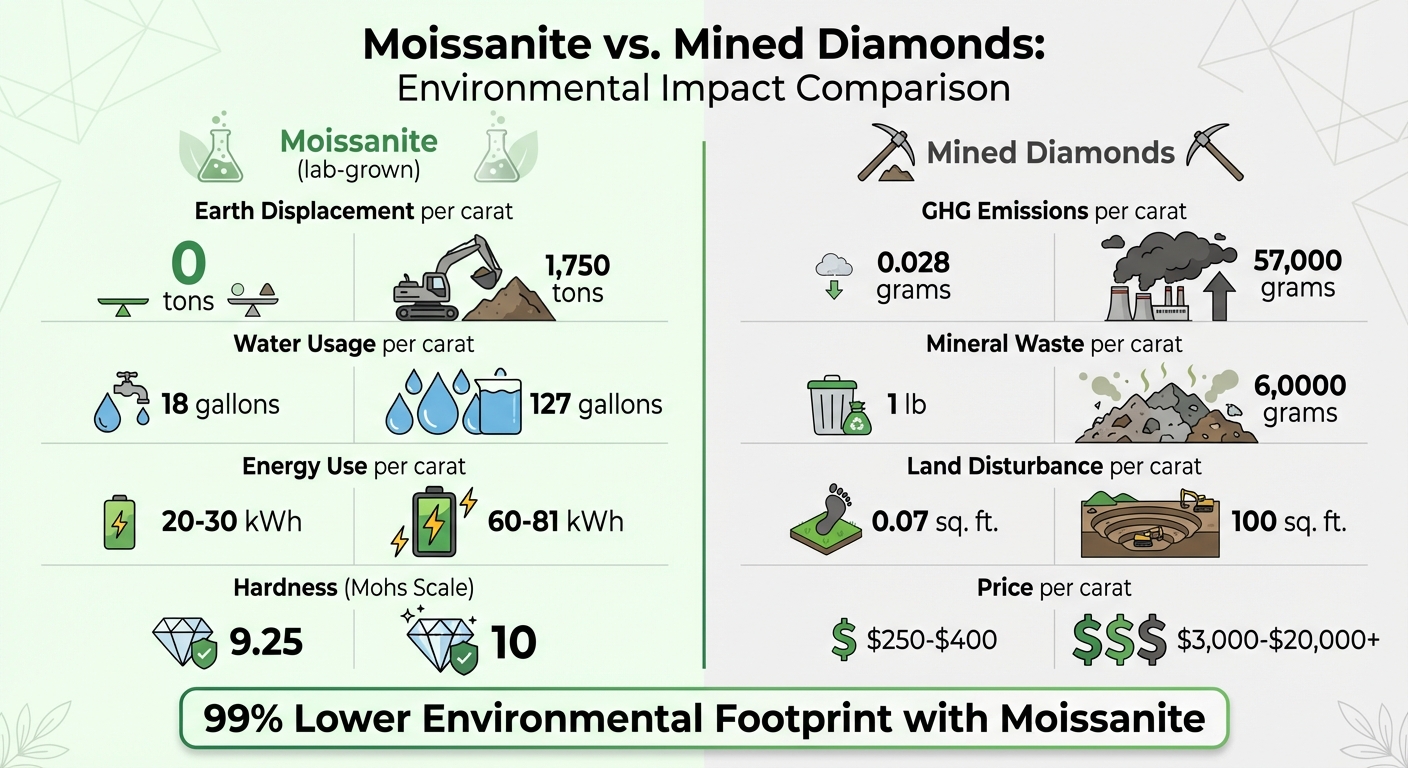
Moissanite vs Mined Diamonds Environmental Impact Comparison
Production Waste: Moissanite vs. Mined Diamonds
When it comes to waste, moissanite production stands out as a far cleaner process compared to diamond mining. For every carat of diamond mined, an astonishing 6,000 pounds of mineral waste is created. In contrast, producing a carat of lab-grown moissanite generates just about 1 pound of waste. That’s a staggering 6,000-to-1 difference in waste production, even before factoring in other environmental consequences.
Let’s take a closer look at some key production metrics - waste, land use, energy, and water consumption. Mining a single carat of diamond disrupts roughly 100 square feet of land, while moissanite production affects only about 0.07 square feet. That’s more than 1,400 times less land disturbance. Energy and water usage tell a similar story: diamond mining consumes between 96 and 150 kWh of energy and 20 gallons of water per carat, while moissanite production via HPHT technology uses around 36 kWh of energy and requires virtually no water. The table below highlights these differences:
| Metric (per carat) | Mined Diamond | Lab-Grown Moissanite |
|---|---|---|
| Mineral Waste | ~6,000 lbs | ~1 lb |
| Land Disturbance | ~100 sq. ft. | ~0.07 sq. ft. |
| Energy Use | 96–150 kWh | ~36 kWh (HPHT) |
| Water Consumption | ~0.077 m³ (~20 gal) | ~0 m³ (0 gal) |
These comparisons highlight how moissanite production aligns with the principles of efficiency and minimal environmental impact. Unlike diamond mining, which relies on large-scale excavation, water-intensive processes, and significant habitat disruption, moissanite production takes a more resource-conscious approach. The result is a gemstone that fits seamlessly into zero-waste jewelry practices, offering a sustainable alternative without compromising on beauty or quality.
Environmental Impact Comparison
When it comes to the environment, moissanite leaves a far smaller footprint compared to mined diamonds. For starters, the greenhouse gas emissions tell a striking story: traditional diamond mining generates about 57,000 grams of emissions per carat. On the other hand, lab-grown moissanite, especially when produced using clean energy, emits just 0.028 grams per carat - a difference of over 2 million times less.
The contrast becomes even starker when you consider the broader environmental toll of diamond mining. Mining operations often dig as deep as 0.6 miles into the earth, removing vast amounts of overburden - sand, soil, and rock - just to access diamond-rich ore. This process doesn't just disrupt the immediate area; it leads to widespread deforestation and damages ecosystems well beyond the mining zones. In comparison, moissanite is created in a controlled lab environment, avoiding land destruction altogether.
Ethical considerations also set these two gemstones apart. Mined diamonds carry risks of funding conflicts and labor exploitation. Moissanite, however, is grown in labs under traceable and ethical conditions, ensuring transparency and fair practices. By eliminating harmful mining practices, moissanite not only reduces waste but also supports responsible sourcing.
| Environmental Factor | Mined Diamonds | Lab-Grown Moissanite |
|---|---|---|
| GHG Emissions (per carat) | 57,000 grams | 0.028 grams |
| Mineral Waste (per carat) | 2.63 tons | 0.0006 tons |
| Water Usage Impact (per carat) | 0.48 m³ (~127 gallons) | 0.07 m³ (~18 gallons) |
| Habitat Impact | Extensive deforestation and ecosystem loss | Minimal to zero land disturbance |
| Ethical Status | Risk of conflict diamonds and labor issues | Verifiable ethical production |
The numbers make it clear: moissanite is a smarter choice for anyone looking to minimize environmental harm. For example, researchers estimate that replacing mined diamonds with lab-grown options could save approximately 714 million cubic meters of landfill space every year. For those seeking sustainable luxury, moissanite offers a way to enjoy fine jewelry without the environmental and ethical baggage.
Rokshok and Zero-Waste Jewelry

Rokshok integrates zero-waste values into every step of its jewelry-making process. The company exclusively sources lab-grown moissanite from Charles & Colvard, a leader in the field. These stones are created under ethical labor conditions while maintaining high environmental standards.
To minimize waste even further, Rokshok uses advanced design techniques. Their custom pieces are crafted with CAD technology, ensuring precise material use from concept to completion. As Rokshok explains, "From the initial design to the final polish, we work closely with our clients to create custom pieces that perfectly capture their vision". By opting for lab-grown gemstones, customers actively avoid supporting harmful mining practices and reduce the environmental footprint tied to traditional gemstone extraction.
Durability is another cornerstone of Rokshok's zero-waste philosophy. Moissanite’s toughness allows the company to offer cleaning, maintenance, and repair services that extend the lifespan of each piece. This approach helps transform jewelry into timeless heirlooms rather than short-lived accessories. To complement this durability, Rokshok uses only the finest precious metals in their designs.
Each moissanite is set in high-quality metals like yellow gold, white gold, platinum, or rose gold, chosen for their ability to endure daily wear for decades. These durable materials not only enhance the jewelry's aesthetic appeal but also align with Rokshok's mission to reduce waste over time. Paired with moissanite’s ability to withstand repairs, these pieces are built to last for generations.
sbb-itb-1bb5b78
Pros and Cons
When comparing moissanite to mined diamonds, the environmental impact tells a compelling story. Each gemstone has unique characteristics when it comes to waste and resource usage.
Moissanite's benefits stand out in nearly every environmental category. Since it's lab-created, there's no need for extensive earth displacement. For instance, moissanite production uses only about 18 gallons of water per carat, compared to a staggering 127 gallons for mined diamonds. Energy consumption is also much lower, with moissanite requiring just 20–30 kWh per carat, whereas mined diamonds use 60–81 kWh. Then there's the price difference: moissanite costs between $250 and $400 per carat, while mined diamonds range from $3,000 to over $20,000. However, moissanite does come with a few trade-offs.
The primary drawback of moissanite is its slightly lower hardness on the Mohs scale - 9.25 compared to a diamond's perfect 10. While this difference might not matter to most, it could concern buyers prioritizing maximum durability. Additionally, some lab production methods, like Microwave-assisted Chemical Vapor Deposition (CVD), may use more energy. These processes also involve hazardous gases such as methane and hydrogen, which require strict handling protocols.
| Feature | Moissanite (Lab-Grown) | Mined Diamond |
|---|---|---|
| Earth Displacement | Zero | ~1,750 tons per carat |
| Water Usage | ~18 gallons per carat | ~127 gallons per carat |
| Energy Use | 20–30 kWh per carat | 60–81 kWh per carat |
| Mineral Waste | ~0.0006 tons per carat | ~2.63 tons per carat |
| GHG Emissions | ~0.028 grams per carat | ~57,000 grams per carat |
| Hardness (Mohs) | 9.25 | 10 |
| Price (1 Carat) | $250–$400 | $3,000–$20,000+ |
This side-by-side comparison highlights moissanite's efficiency in terms of environmental impact, even with a few minor compromises. These factors align closely with Rokshok's commitment to zero-waste luxury.
The environmental advantages of moissanite far outweigh its small disadvantages. A report in Nature reveals that transitioning to lab-grown diamonds could annually save 714 million cubic meters of landfill space, produce enough rice to feed 436 million people, and lift 1.19 million households out of hunger. These numbers emphasize the positive impact of choosing moissanite over traditional mined diamonds.
Conclusion
Moissanite is making waves as a game-changer in the pursuit of zero-waste jewelry. Unlike mined diamonds, which require shifting about 1,750 tons of earth per carat and consuming up to 127 gallons of water, moissanite is produced in a lab with minimal environmental disruption. In fact, it uses just 18 gallons of water per carat and causes no land disturbance, cutting its environmental footprint by an estimated 99%. Its durability is another standout feature - boasting a 9.25 rating on the Mohs hardness scale, moissanite resists wear and tear, reducing the need for frequent replacements and keeping jewelry out of landfills. This combination of reduced resource consumption and long-lasting quality makes it a smart choice for sustainable luxury.
For those looking to maximize sustainability, it’s worth considering additional factors like renewable energy in production, recycled metals, and brands that offer repair services or timeless designs. Rokshok exemplifies this approach, blending premium moissanite with ethically sourced materials to create custom designs that align with circular economy principles. Their commitment to sustainability is evident in every step of their design process.
Opting for moissanite over traditional diamonds is more than just a style choice - it’s a meaningful step toward reducing waste and enjoying luxury without the environmental cost.
FAQs
What makes moissanite a more eco-friendly choice compared to diamonds?
Moissanite stands out as a more eco-friendly option compared to diamonds. Mining diamonds involves massive excavation projects, heavy machinery, and immense consumption of water and energy. This process generates a staggering amount of greenhouse gases and waste. To put it into perspective, producing just one carat of diamond can result in tens of thousands of grams of CO₂ emissions and over two tons of mineral waste.
On the other hand, moissanite is created in a lab under controlled conditions that prioritize sustainability. These processes recycle water and use energy more efficiently, completely avoiding the harmful environmental effects of traditional mining. By choosing moissanite, you’re not only selecting a stunning, high-quality gemstone but also supporting practices that are kinder to the planet.
Why is moissanite considered an eco-friendly choice for jewelry?
Moissanite stands out as an environmentally conscious option since it’s created in laboratories, eliminating the need for mining. This method safeguards natural ecosystems by avoiding land disruption, cutting down on water consumption, and preventing soil contamination. Plus, producing moissanite in controlled settings generates far fewer carbon emissions compared to traditional gemstone mining.
Opting for moissanite means embracing sustainable practices that align with eco-friendly values while enjoying a dazzling, top-tier gemstone.
Is moissanite durable enough for everyday wear?
Moissanite is highly durable and perfect for everyday wear. Scoring just below diamonds on the Mohs scale of hardness, it’s resistant to scratches and retains its sparkle over time. While it’s not as hard as a natural diamond, it’s tough enough to endure daily activities without compromising its brilliance or structure.
This durability, paired with its ethical and environmentally conscious sourcing, makes moissanite a fantastic option for those seeking sustainable and long-lasting jewelry.
