
Colorless vs Near Colorless Moissanite

When choosing moissanite, the key decision lies between colorless (D-E-F grades) and near colorless (G-H-I-J grades) stones. Here's the breakdown:
- Colorless moissanite offers an icy-white, diamond-like appearance with no visible tint. It pairs best with white metals like platinum or white gold and is ideal for those seeking a premium look. However, it comes at a higher price.
- Near colorless moissanite has slight hints of warmth (yellow, gray, or green), noticeable only under certain lighting or with trained eyes. It’s more affordable and works well with yellow or rose gold settings, making it a budget-friendly choice for larger stones or intricate designs.
Both options deliver durability (9.25 on the Mohs scale) and exceptional sparkle. Your choice depends on your style, budget, and metal preference.
Quick Comparison
| Feature | Colorless (D-E-F) | Near Colorless (G-H-I-J) |
|---|---|---|
| Appearance | Pure white, no visible tint | Subtle warmth, faint tint |
| Best Metal Pairing | Platinum, white gold | Yellow gold, rose gold |
| Price | Higher | More affordable |
| Ideal Use | Luxury, sleek designs | Larger stones, vintage styles |
Choose colorless for a polished, diamond-like sparkle or near colorless for a softer glow and cost savings.
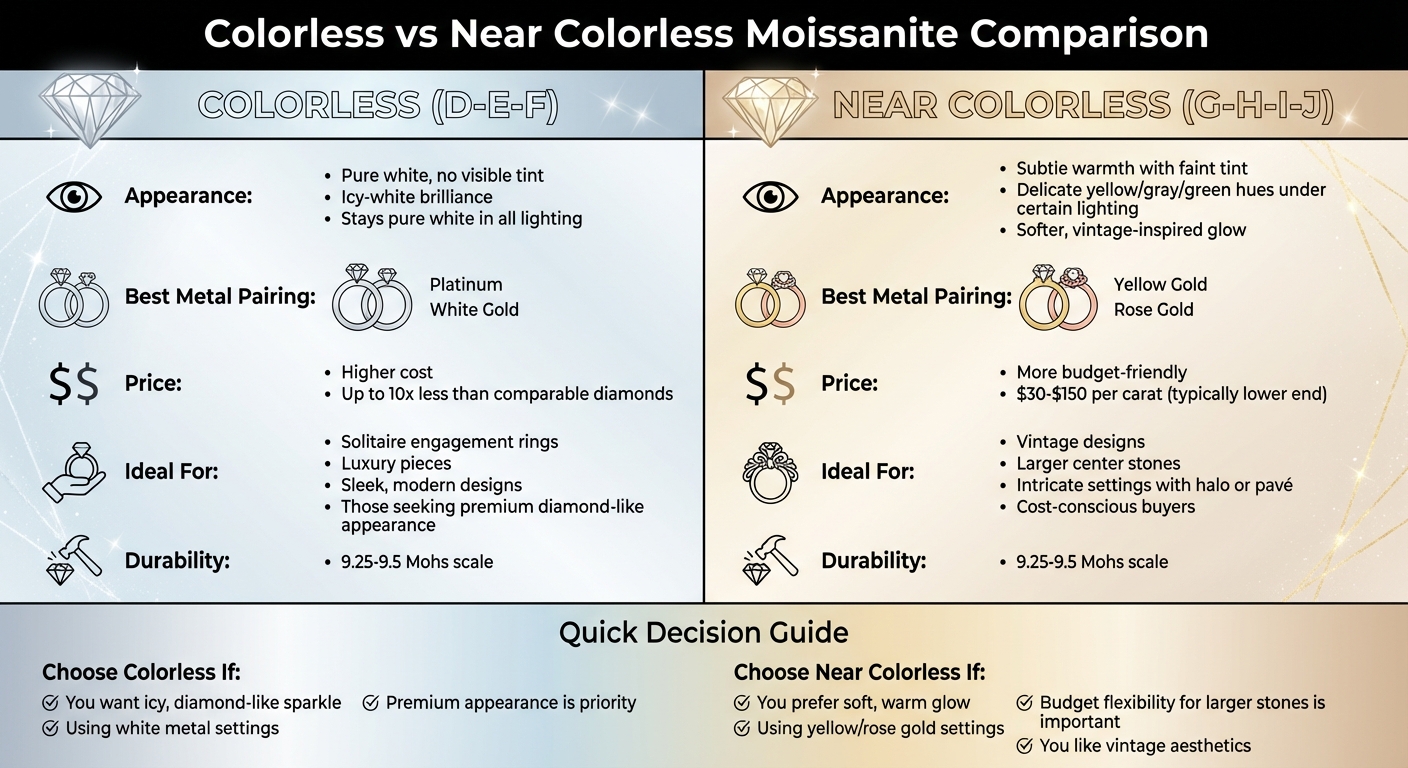
Colorless vs Near Colorless Moissanite Comparison Guide
Colorless Moissanite: D-E-F Grades
What Qualifies as Colorless (D-E-F Grades)
In the world of moissanite grading, colorless stones stand out for their unmatched clarity and brilliance, making them a top choice for those seeking a diamond-like appearance. D–E–F grade moissanite is defined by its lack of body color, creating a stunning icy-white look. To determine this grade, gemologists evaluate loose stones against a neutral white background under specialized lighting, ensuring any hint of body color is revealed.
Each stone is compared to a set of master stones to confirm its grade. D-grade stones are entirely colorless, while E and F grades may have the faintest traces of color, visible only to trained professionals using 10x magnification. As Janice McGowan, a Grading Specialist at Charles & Colvard, explains:
"I grade each stone for clarity before grading for color. This involves looking at the stone once through a jeweler's loupe, then rotating the stone and louping it again to confirm. Once I've determined the clarity grade, I then grade for color by comparing the stone to a set of master stones".
Brilliance, Fire, and Clarity
Colorless moissanite is celebrated for its ability to reflect light beautifully, creating a dazzling sparkle. When paired with white metals like platinum or white gold, the icy-white tone of these stones is further emphasized. Thanks to moissanite's high refractive index and its unique double refraction, these stones display exceptional "fire" - those mesmerizing rainbow flashes that catch the eye.
High-quality colorless moissanite often boasts impressive clarity, typically ranging from FL (Flawless) to VS1 (Very Slightly Included). However, achieving maximum brilliance depends heavily on the cut. Without an "Excellent" or "Ideal" cut, even the most colorless stone can lose its sparkle. Bob Curry, Senior Vice President at Charles & Colvard, highlighted the significance of this achievement:
"Moissanite has never existed as a colorless stone until now. The fact that we have been able to create moissanite in D-E-F color is truly amazing".
Pricing and Market Position
Due to its rarity in production and the high demand for its diamond-like appearance, colorless moissanite is the most expensive option in the moissanite market. However, it remains an affordable alternative to natural diamonds - costing up to 10 times less than a diamond of comparable size and quality.
This price point makes colorless moissanite a smart choice for buyers seeking premium aesthetics without breaking the bank. For stones larger than 1 carat, the importance of the colorless grade becomes even more pronounced, as lower grades can reveal noticeable yellow or green tints in larger sizes. Emma Zerner, a Graduate Gemologist at IceCartel, underscores this premium positioning:
"Colorless diamonds and moissanite are considered true investments - perfect for those who demand nothing but the best".
This sets the stage for exploring how near colorless moissanite compares next.
sbb-itb-1bb5b78
Colorless v. Near Colorless Moissanite, Diamonds & Gemstones
Near Colorless Moissanite: G-H-I-J Grades
Shifting from the dazzling D–E–F range, near colorless moissanite in the G–H–I–J grades introduces a gentle warmth while offering some distinct perks.
What Qualifies as Near Colorless (G-H-I-J Grades)
Near colorless moissanite is just a step below the colorless category, with faint hints of warmth that are hard to detect without close examination. These stones may reveal slight yellow, gray, or brown undertones, noticeable only under specific conditions. Emma Zerner, a Graduate Gemologist at ICECARTEL, describes it this way:
"Near colorless moissanite is defined as having only minute traces of color detectable by a trained eye under observation".
The grading within this range varies. G-grade stones have the least noticeable color, while J-grade stones lean slightly warmer. However, when viewed on their own - without comparison to a colorless stone - most people won’t see much difference. This subtle distinction adds to the charm of near colorless moissanite, especially in different settings.
Appearance and Subtle Warmth
Unlike the crisp, icy appearance of D–E–F moissanite, near colorless stones offer a softer glow. This warmth becomes more apparent in larger stones, particularly those over 1 carat, and under certain lighting conditions, where faint yellow or green hues might emerge.
That said, the brilliance of the stone remains undiminished. As Harlem Bling notes:
"Near colorless moissanite (G-H-I grade) has a slightly warmer hue but still boasts remarkable sparkle, sometimes even surpassing natural diamonds".
The choice of setting can make a big difference in how the warmth is perceived. Yellow or rose gold settings enhance the natural warmth, making any tint almost invisible. On the other hand, white gold or platinum can highlight the subtle color contrast.
Cost and Value Comparison
For buyers looking to stay within a budget, near colorless moissanite offers exceptional savings. A one-carat moissanite generally ranges from $30 to $150, with near colorless grades typically priced on the lower end. Emma Zerner emphasizes the appeal:
"Near colorless moissanite still exhibits all the fire and sparkle at a fraction of the price of higher color grades".
These savings allow you to opt for a larger stone or splurge on a more elaborate setting. J-grade moissanite, in particular, is a popular choice for those seeking size and brilliance without the higher price tag. As Zerner points out:
"J color diamonds are quite common and popular on the market... offering all the brilliance and shine of a diamond without the higher price tags".
For anyone prioritizing sparkle and size over absolute colorlessness, the G-H-I-J range strikes a perfect balance, delivering beauty and value that’s hard to beat for the price.
Colorless vs Near Colorless: Direct Comparison
How They Look Under Different Lighting
When it comes to lighting, the differences between Colorless (D-E-F) and Near Colorless (G-H-I-J) moissanite become even more apparent. Colorless moissanite maintains its icy white brilliance whether you're under fluorescent lights or natural sunlight.
Near Colorless moissanite, however, reveals its personality in specific lighting conditions. As Harlem Bling explains:
"Under certain light conditions, near-colorless moissanite gives off delicate yellow or green hues, whereas its colorless counterpart exhibits a consistently pure white shine."
These subtle tints are most noticeable when stones are compared side-by-side or viewed under bright light. Even the type of metal setting can play a role in emphasizing or downplaying these differences.
These visual distinctions aren't just aesthetic - they can also influence your budget.
Price Differences and Budget Impact
The difference in appearance directly ties into pricing. Colorless moissanite typically commands a higher price tag. On the other hand, Near Colorless stones are a more economical option. This price gap can significantly impact your choices. For example, instead of choosing a smaller colorless stone, you could opt for a larger Near Colorless stone within the same budget. Alternatively, the savings could go toward adding intricate details like pavé accents or a halo design. According to Harlem Bling, Near Colorless moissanite allows for larger sizes or more elaborate settings without stretching your budget too far.
Comparison Table: Key Differences
Here’s a quick side-by-side look at the main differences:
| Feature | Colorless Moissanite (D-E-F) | Near Colorless Moissanite (G-H-I-J) |
|---|---|---|
| Visual Appearance | Icy-white, no visible tint | Subtle warmth; faint yellow/gray/green hues |
| Lighting Reaction | Stays pure white in all lighting | Tints may appear under specific lighting |
| Best Metal Pairing | Platinum, White Gold | Yellow Gold, Rose Gold |
| Price Range | Higher cost | More budget-friendly |
| Diamond Similarity | Closely resembles high-grade diamonds | Comparable to slightly warmer natural diamonds |
| Recommended For | Solitaire engagement rings, luxury pieces | Vintage designs, larger center stones, cost-conscious jewelry |
How to Choose Between Colorless and Near Colorless
Match Your Personal Style
Your choice between colorless and near-colorless moissanite should reflect your personal style. If you’re drawn to a sleek, modern aesthetic with a bright, diamond-like shimmer, colorless moissanite is the way to go. On the other hand, near-colorless moissanite offers a softer, vintage-inspired charm with a subtle warmth that many find romantic.
The faint tint in near-colorless stones gives them a gentle glow, which some prefer over the stark brightness of colorless stones. As Emma Zerner, Graduate Gemologist at ICECARTEL, puts it:
"H color stones offer prestige at a great value".
Ultimately, your style preference should align with your budget to ensure you make the best choice.
Balance Quality and Budget
If budget plays a significant role in your decision, near-colorless moissanite is a smart option. It offers a brilliant sparkle and allows you to save money, which can be used for larger stones or more intricate settings.
Colorless moissanite, while pricier due to its rarity, is worth considering if you’re opting for platinum or white gold settings. These metals tend to accentuate any warmth in near-colorless stones, making the extra investment in D–E–F grades worthwhile. The key is determining whether the visual difference aligns with your priorities and justifies the added cost.
Consider Your Jewelry Setting and Metal
The metal and setting of your jewelry can significantly influence the appearance of your moissanite. White metals like platinum or white gold amplify the crisp, icy brilliance of colorless stones, while yellow and rose gold enhance the warm undertones of near-colorless moissanite. This pairing ensures that the stone and metal work together to create a harmonious look. As Harlem Bling notes:
"A colorless stone pairs beautifully with white gold or platinum for a sleek, modern look, while near-colorless moissanite can enhance the warmth of yellow or rose gold settings".
The style of the setting also matters. Solitaire designs emphasize the stone’s clarity and purity, making colorless grades stand out. Meanwhile, halo settings can add extra sparkle, masking slight color variations in near-colorless stones and even creating the illusion of a larger gemstone.
Conclusion
Deciding between colorless and near colorless moissanite comes down to your personal preferences, budget, and the type of metal setting you have in mind. As outlined earlier, colorless moissanite (D-E-F) delivers a crisp, icy-white brilliance that's comparable to top-tier diamonds, perfect for those who want a flawless, diamond-like sparkle. On the other hand, near colorless moissanite (G-H-I-J) offers a touch of warmth that’s often subtle and hard to notice without close inspection. This makes it a great choice for those aiming to balance quality with affordability, allowing for larger stones or more intricate designs within a budget.
Both grades share exceptional durability, scoring 9.25 to 9.5 on the Mohs scale, and showcase the dazzling fire and brilliance moissanite is known for. Pairing the stone with the right metal setting can further enhance its appearance - white metals like platinum highlight the cool tones of colorless stones, while yellow or rose gold beautifully complement the warmth of near colorless gems.
If you’re drawn to the icy, diamond-like look and plan to use a white metal setting, colorless moissanite is the way to go. However, if you’re looking for a more budget-friendly option or prefer the soft glow of warmer metals, near colorless moissanite offers excellent quality without compromise. As Emma Zerner, Graduate Gemologist at IceCartel, explains:
"Colorless diamonds and moissanite are considered true investments--perfect for those who demand nothing but the best".
Whichever you choose, both options provide stunning, durable gemstones that are designed to last. Your decision ultimately reflects whether you prioritize the highest color grade or prefer to maximize your budget for a larger, more striking piece.
FAQs
Will a near-colorless moissanite look yellow in real life?
A near-colorless moissanite typically exhibits a faint yellow or green tint, particularly within the G-H-I color range. While it may look almost colorless to the naked eye, factors like lighting and individual perception can make this slight warmth more apparent. That said, the tint is far less pronounced than in stones with lower color grades. This makes near-colorless moissanite an appealing choice for those seeking a bright, white appearance at a more budget-friendly price.
Which moissanite color grade looks best in white gold or platinum?
For white gold or platinum settings, colorless moissanite (D, E, F grades) is a fantastic choice. It delivers a bright, diamond-like sparkle that pairs beautifully with the cool tones of these metals. Near-colorless grades (G, H, I) can also create a striking look, adding a hint of warmth for something a bit different. However, if you're after a classic, icy-white appearance, D-F grades remain the top pick.
Should I prioritize color grade or cut for the most sparkle?
When it comes to moissanite, the cut plays the biggest role in creating that dazzling sparkle. A high-quality cut - like a round cut featuring over 50 facets - maximizes light reflection, giving the stone its signature brilliance.
Although the color grade (with D-F being colorless) can influence appearance, it’s the cut that truly determines how much the stone sparkles. Choosing a well-cut moissanite ensures your jewelry will catch the light and shine beautifully.
