
Top 5 Benefits of Lab-Created Moissanite

Lab-created moissanite is a brilliant alternative to diamonds, offering affordability, durability, and ethical sourcing. Here’s why it’s gaining popularity:
- Eco-Friendly: Lab-grown moissanite avoids mining, using 90% fewer resources and producing significantly less CO₂.
- Budget-Friendly: Costs 10–15% of a diamond’s price, with 1-carat stones priced between $400–$800.
- Durable: With a 9.25 Mohs hardness, it resists scratches and is ideal for daily wear.
- Conflict-Free: Produced in controlled environments, ensuring no ties to unethical practices.
- High Sparkle: Its superior refractive index creates more light and rainbow-like flashes than diamonds.
Moissanite combines affordability, ethical production, and stunning brilliance, making it a standout choice for modern jewelry.
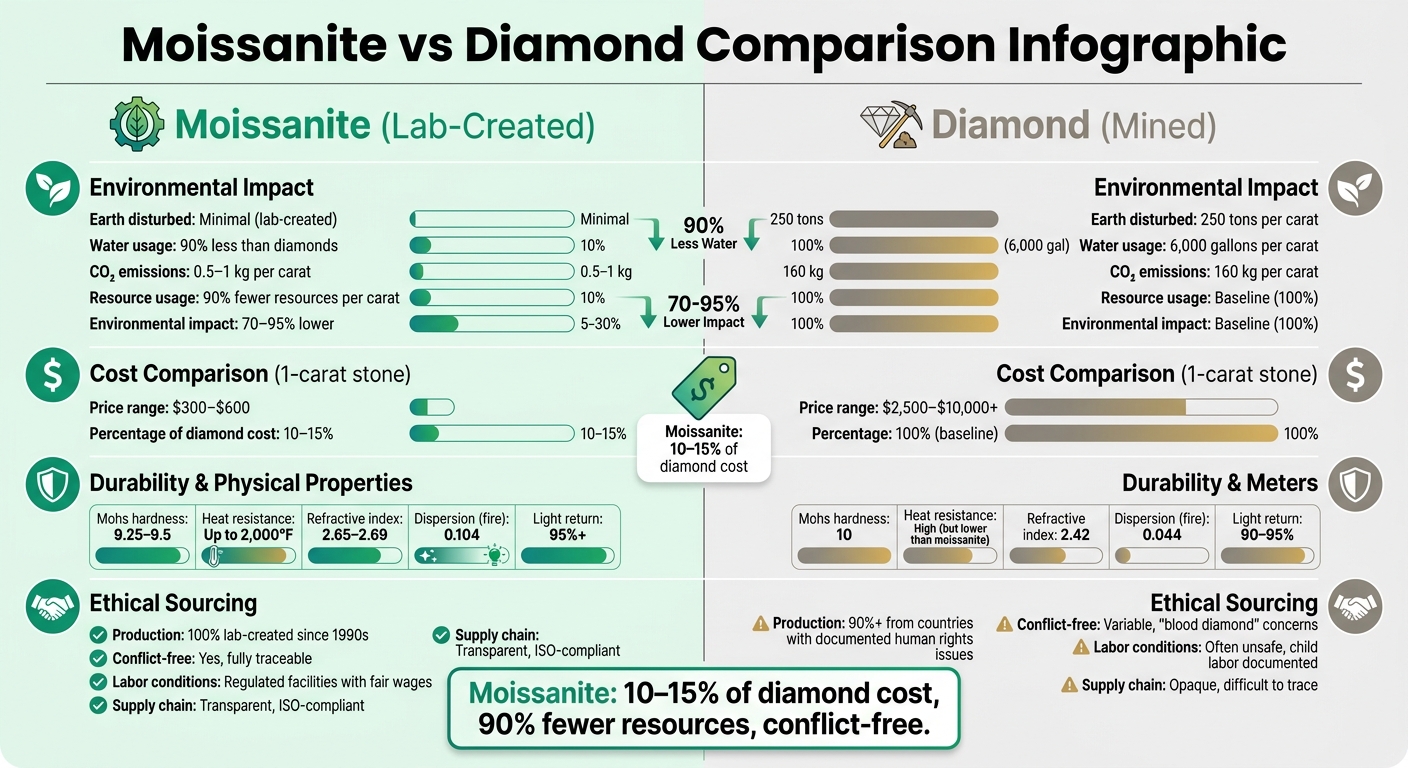
Moissanite vs Diamond: Environmental Impact, Cost, and Durability Comparison
5 Reasons Moissanite is Best Diamond Alternative
sbb-itb-1bb5b78
1. Eco-Friendly and Sustainable Production
Lab-created moissanite offers a greener alternative to traditional gemstones by skipping the mining process entirely. Instead, these gems are produced in controlled environments using chemical vapor deposition (CVD) or high-pressure high-temperature (HPHT) methods. This approach avoids the environmental devastation caused by mining, such as habitat destruction, soil erosion, and water contamination.
To put things into perspective, mining a single carat of diamond can disturb up to 250 tons of earth and consume around 6,000 gallons of water. In contrast, lab-grown moissanite requires far fewer raw materials, recycles its byproducts, and cuts resource usage by over 90% per carat. It also emits only 0.5–1 kg of CO₂ per carat, compared to the staggering 160 kg of CO₂ generated by mined diamonds.
"Moissanite is created from silicon carbide, a process that uses significantly fewer resources and energy compared to the mining of natural gemstones." - Rokshok
Another advantage is traceability. U.S. consumers can rely on lab certificates that clearly document the gem's origin from ISO-compliant facilities, something often lacking in the opaque supply chains of mined gems. Companies like Rokshok go a step further by offering blockchain-verified eco-certifications, ensuring the entire process is environmentally responsible from beginning to end.
Lab-created gems, including moissanite, have 70–95% lower environmental impact in terms of energy consumption and waste compared to their mined counterparts. With demand for lab-grown gemstones projected to increase by 55% between 2020 and 2025, moissanite stands out as one of the most sustainable and eco-conscious gemstone options available today.
2. Affordable Pricing with High Quality
Lab-created moissanite stands out not just for its ethical production but also for its budget-friendly pricing. To put it in perspective, a 1-carat moissanite generally costs between $300 and $600, whereas a natural diamond of the same size can range from $2,500 to over $10,000. That means moissanite is roughly 10–15% of the price of a diamond. This makes it an ideal choice for anyone looking to enjoy luxury without overspending.
One of the biggest perks? You can go for larger stones without breaking the bank. For instance, an 8.0 mm moissanite gives the same visual impression as a 2-carat diamond. Since moissanite is less dense than diamond, it offers a bigger look while keeping costs in check. And this affordability isn’t just about price - it extends to its durability and brilliance, ensuring long-lasting value.
What’s impressive is that affordability doesn’t mean compromising on quality. Moissanite boasts high hardness and exceptional light performance, making it both durable for daily wear and endlessly brilliant.
"In my studio I see the same question every week: moissanite or lab-grown diamond? Once you understand how each stone handles light, durability, and budget, the 'right' choice becomes very clear for your story and your ring." – Sergiy Shvets, Jeweler and Founder, Ivanov Jewelry
This cost advantage also allows you to allocate more of your budget toward custom features like intricate metalwork, unique settings, or matching wedding bands. Instead of spending most of your money on the center stone, you can invest in personalized, ethically crafted designs. Unlike other simulants like cubic zirconia, which can dull over time, moissanite maintains its brilliance indefinitely thanks to its exceptional hardness. Whether you’re working with a tight budget or simply want to spend wisely, moissanite offers high-end quality at a fraction of the price.
3. Hard and Durable for Daily Use
When it comes to jewelry that can stand up to daily life, durability is a must. Lab-created moissanite scores an impressive 9.25 to 9.5 on the Mohs scale of hardness, making it the second hardest gemstone used in jewelry - just behind diamonds, which score a perfect 10. To give you an idea, moissanite is tougher than sapphires and rubies (both at 9), topaz (8), and cubic zirconia (8–8.5). This means it can handle everyday encounters with abrasive surfaces like keys or countertops without scratching. Its hardness lays the foundation for its other rugged qualities.
But there’s more to moissanite’s durability than just hardness. It also resists scratches and boasts exceptional toughness and heat resistance, tolerating impacts and temperatures as high as 2,000°F - far beyond what a typical house fire could reach. Whether you're typing away at work, hitting the gym, or tackling hands-on tasks, moissanite is built to endure. Plus, its thermal stability ensures it stays intact during professional repairs like resizing.
"In my bench work, I've noticed Moissanite can withstand setting processes that sometimes stress other gemstones. It's remarkably resilient." – Elena Rodriguez, Jewelry Designer
Maintaining moissanite is refreshingly simple. A quick weekly clean with warm water and mild soap keeps it sparkling, and storing it in a soft pouch prevents it from scratching other pieces. For added peace of mind, have a jeweler check the metal setting every 12 to 18 months to ensure the prongs remain secure. Its ability to handle life’s daily demands makes moissanite a practical choice for a variety of lifestyles.
4. Conflict-Free and Ethically Produced
Lab-created moissanite addresses the ethical concerns often tied to traditional gemstone mining, such as funding conflicts and child labor. Unlike mined diamonds - where over 90% of rough stones originate from a handful of countries with documented human rights abuses and child labor issues - moissanite is created entirely in laboratory settings. This ensures no association with conflict financing, like the "blood diamonds" linked to regions such as Sierra Leone and Angola.
In addition to its environmental benefits, moissanite production adheres to strict ethical standards. Made from silicon carbide crystals in high-pressure reactors, lab-grown moissanite is fully traceable and complies with rigorous labor regulations. Reputable brands back this up with detailed documentation, including certifications for their facilities and proof of fair wages and safe working conditions.
"This ethically-sourced alternative provides a dazzling appearance while ensuring that ethical standards are met throughout the production process." – Rokshok
The difference between lab-created moissanite and mined gemstones is stark. Mined diamonds are often associated with unsafe working conditions and worker exploitation. In contrast, moissanite is produced in advanced facilities, primarily in developed countries with strong labor protections. Its creation involves no forced labor, no environmental destruction from open-pit mining, and no displacement of local communities. This makes moissanite a clear ethical choice for those who care about the origins of their jewelry.
Since nearly all jewelry-grade moissanite has been lab-grown since the 1990s, choosing it reflects a commitment to ethical consumption and responsible sourcing. For buyers who value socially conscious luxury, moissanite delivers stunning brilliance without the moral compromises of traditional gemstones.
5. High Sparkle and Design Flexibility
Lab-created moissanite is known for its dazzling optical performance, often surpassing diamonds in brilliance. With a refractive index of 2.65–2.69 compared to a diamond's 2.42, moissanite reflects more light, creating a striking sparkle. Its dispersion index of 0.104 - over 2.5 times higher than a diamond's 0.044 - produces vibrant rainbow-like flashes, even in dim lighting conditions. This exceptional light performance opens up a world of design possibilities.
Moissanite comes in a wide array of cuts - more than 10, to be exact. These include popular shapes like round brilliant, princess, cushion, emerald, pear, oval, marquise, radiant, asscher, and heart. It can be crafted into anything from delicate 0.5-carat accent stones to bold statement pieces exceeding 20 carats.
Beyond its sparkle, moissanite's durability adds to its design versatility. With a hardness of 9.25 on the Mohs scale, it can be used in a variety of settings, such as prong, bezel, halo, pavé, channel, and tension styles. This makes it a perfect match for different precious metals. Rokshok, for instance, uses this flexibility to create eco-conscious jewelry that balances elegance with ethical values. Their custom moissanite designs - ranging from stackable rings to layered necklaces - highlight the stone's fiery brilliance.
Lab tests further underscore moissanite's superior light performance, showing light return rates exceeding 95% in ideal cuts, compared to diamond's 90–95%. In blind comparisons, 80% of consumers preferred moissanite's brighter sparkle. Whether you're envisioning a 10-carat oval halo ring, a cushion-cut bracelet with pavé details, or pear-shaped drop earrings in white gold, moissanite ensures unmatched visual appeal.
Conclusion
Lab-created moissanite offers a combination of eco-consciousness, affordability, durability, ethical sourcing, and stunning brilliance. Let’s quickly revisit the top five reasons why it’s a standout choice:
- Eco-Friendly Production: Avoids the environmental harm caused by traditional mining.
- Affordable Luxury: Priced at roughly 10% of what a comparable diamond costs.
- Durability for Everyday Use: With a 9.25 rating on the Mohs scale, it’s tough enough for daily wear.
- Conflict-Free and Ethically Made: Its lab-grown origin ensures no ties to unethical mining practices.
- Exceptional Sparkle and Design Versatility: Known for its dazzling fire and adaptability for various jewelry designs.
When you weigh these benefits, lab-created moissanite truly shines as a sustainable, luxurious alternative. Explore premium, eco-conscious options at Rokshok. Rokshok specializes in ethically sourced rings, earrings, bracelets, and necklaces, all crafted with advanced CAD technology. Choose from yellow gold, white gold, platinum, or rose gold. They also offer free shipping on all orders and boast a 4.8/5 rating from over 2,500 reviews, ensuring quality craftsmanship and ethical practices.
Elevate your jewelry collection with Rokshok's lab-created moissanite - beautiful, ethical, and affordable.
FAQs
How do I tell moissanite from a diamond in person?
Moissanite stands out with its rainbow-like flashes of sparkle, which differ from the white brilliance typically seen in diamonds. In terms of durability, moissanite ranks slightly lower on the Mohs scale with a hardness of 9.25, compared to diamond's perfect 10. It’s also a more budget-friendly option.
Will moissanite get cloudy or lose its sparkle over time?
Moissanite stands out for its ability to retain its sparkle and clarity over time. Thanks to its impressive durability - measuring 9.25 on the Mohs scale - and its resistance to scratches, it remains brilliant for years. With regular cleaning, you can keep its shine looking as radiant as ever.
What should I look for on a moissanite certificate?
When evaluating a gemstone, check its clarity grade - for example, VVS (Very Very Slightly Included) or FL (Flawless). Additionally, make sure it comes with a reputable certification or grading report, such as one from GRA or GIA. These certifications confirm the quality and authenticity of the moissanite.
