
How to Design Personalized Wedding Bands

Your wedding band is more than jewelry - it’s a daily symbol of your relationship. Designing personalized rings means choosing options that reflect your story, lifestyle, and values. From engraving meaningful dates to selecting eco-friendly materials like lab-created moissanite and recycled metals, every detail can make your bands special. Here’s a quick guide to creating custom wedding bands:
- Personalization Options: Add engravings (dates, initials, symbols), unique materials (meteorite, wood inlays), or hidden gemstones.
- Material Choices: Titanium, gold, platinum, and moissanite offer durability and style. Lab-grown gems save 80–90% compared to diamonds.
- Design Process: Work with jewelers to define your vision, budget ($1,000–$10,000 per pair), and practical needs. Use CAD previews to perfect the design.
- Fit and Comfort: Select proper sizing, band width (4–6mm is common), and finishes like matte or hammered for durability.
MY WEDDING RING: Choosing & Designing My Custom Wedding Band!
Define Meaning, Lifestyle, and Budget
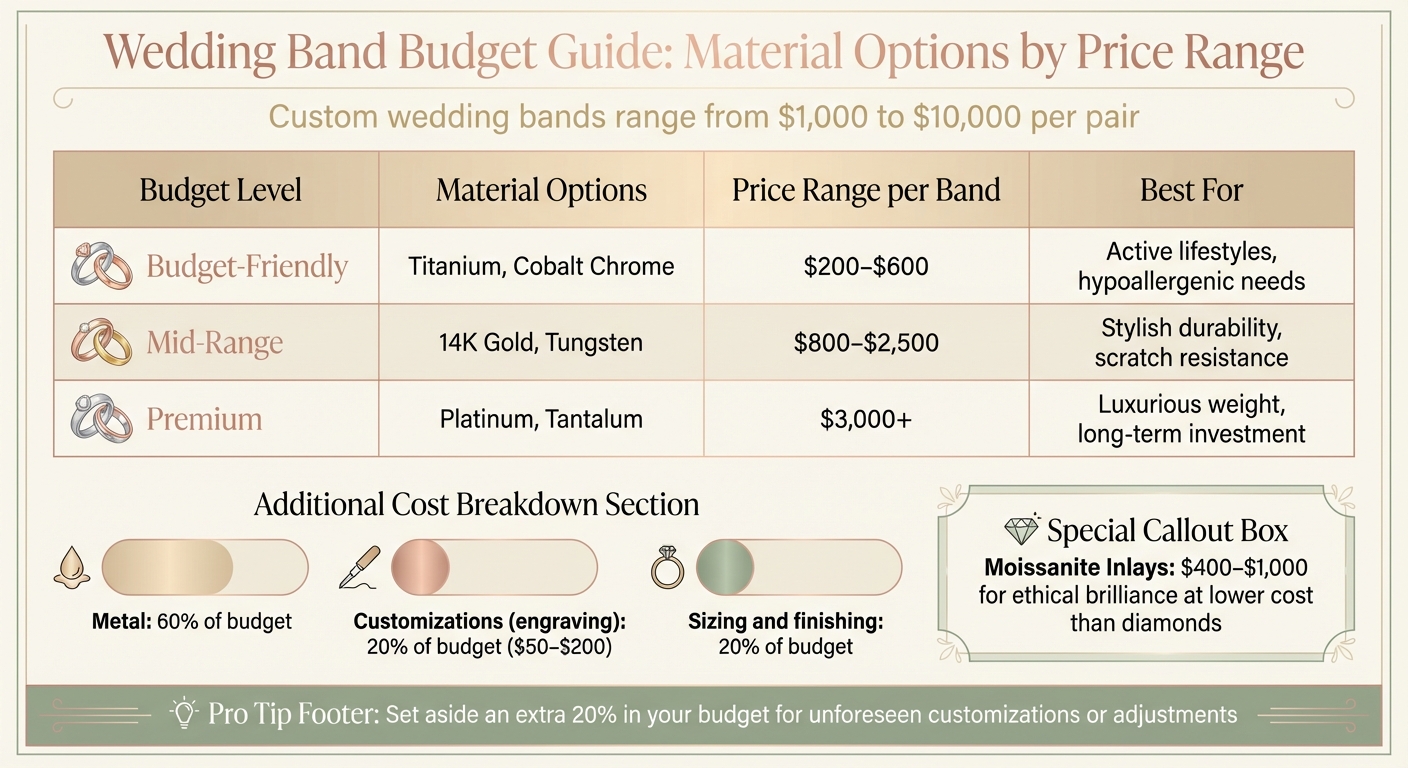
Wedding Band Budget Guide: Material Options and Price Ranges
Clarify the Symbolism Behind the Design
Start by thinking about the moments that define your relationship. Was it where you first met? A shared passion or hobby? These details can inspire the design of your ring. Incorporate engraving options like meaningful dates, coordinates, or symbols that tell your unique story. Essentially, the ring becomes more than just jewelry - it’s a piece of your shared history. Also, think about how your daily routine might influence the design and materials. A ring should not only be meaningful but also practical for your everyday life.
Consider Daily Lifestyle and Practicality
Your job and hobbies play a big role in determining the best materials for your ring. For instance, if you work in a physically demanding job, materials like tungsten or titanium are durable and scratch-resistant. Titanium is also lightweight and hypoallergenic, making it great for outdoor enthusiasts or those with sensitive skin. If you spend a lot of time typing at a desk, lighter materials like carbon fiber can prevent finger fatigue. Chefs or anyone working around chemicals should avoid softer metals like gold, which can wear down quickly.
It’s also worth testing how the ring feels during your daily activities. For example, if you wear gloves or work with machinery, make sure the band won’t snag or get in the way. Once you’ve considered these practical details, you can start aligning your budget with your design priorities.
Set a Realistic Budget
Custom wedding bands can range from $1,000 to $10,000 per pair, depending on the materials and level of customization. Here’s a general breakdown to help you plan: allocate about 60% of your budget to the metal, 20% to customizations (like engraving, which usually costs $50–$200), and 20% to sizing and finishing.
The material you choose has a big impact on cost. For example:
- Titanium or cobalt chrome bands are durable and cost $200–$600 each.
- 14K gold or tungsten rings fall in the $800–$2,500 range, offering style and scratch resistance.
- Platinum and tantalum are premium options starting at $3,000 and up, offering a luxurious feel and long-term durability.
If you’re considering additional elements like moissanite inlays, expect to spend $400–$1,000 for their ethical brilliance at a lower price than diamonds.
| Budget Level | Material Options | Price Range per Band | Best For |
|---|---|---|---|
| Budget-Friendly | Titanium, Cobalt Chrome | $200–$600 | Active lifestyles, hypoallergenic needs |
| Mid-Range | 14K Gold, Tungsten | $800–$2,500 | Stylish durability, scratch resistance |
| Premium | Platinum, Tantalum | $3,000+ | Luxurious weight, long-term investment |
Pro tip: Always set aside an extra 20% in your budget for unforeseen customizations or adjustments. It’s also a good idea to consult with jewelers early in the process to make sure your vision aligns with your budget. For instance, Rokshok offers sustainable, custom designs starting at $500, giving you a great mix of quality and affordability.
Select Materials and Band Structure
When designing a wedding band, your choice of materials and structure should reflect both your personal style and practical needs. Let’s explore the options to help you make a thoughtful decision.
Choose Metals for Durability and Style
The metal you select plays a big role in both the aesthetics and durability of your ring. Yellow gold offers a timeless, warm look that’s made a comeback in recent years in the U.S. It’s available in 14K and 18K options - 14K contains more alloy metals, making it more scratch-resistant and ideal for active lifestyles. White gold, with its sleek, modern appearance, requires rhodium plating every 1–2 years to maintain its finish. For a romantic touch, rose gold combines gold with copper to create a pinkish hue. It’s as durable as yellow gold and requires minimal upkeep.
If you’re looking for something premium, platinum is a standout choice. Though it costs 2–3 times more than 14K gold (expect $1,500+ for a ring versus $500–$1,000 for gold), platinum is naturally white, hypoallergenic, and resistant to tarnishing. Unlike gold, when platinum scratches, the metal shifts rather than wears away, developing a soft patina over time. Its density also gives it a heavier, more substantial feel. For those who prefer durability without frequent maintenance, platinum or palladium is a better option than rhodium-plated white gold.
Once you’ve chosen your metal, consider adding gemstones to make your design even more unique.
Incorporate Gemstones and Moissanite
Gemstones can elevate a simple band into something truly personal. Moissanite is a standout choice for its eco-friendly appeal and dazzling brilliance. With a refractive index of 2.65, it sparkles even more than diamonds and is tough enough for daily wear, scoring 9.25 on the Mohs hardness scale. It’s also budget-friendly, costing around $600 for a 1-carat stone compared to $5,000+ for a diamond of the same size.
Rokshok offers premium moissanite jewelry with custom design options, allowing you to choose from cuts like princess, cushion, or emerald to complement your band. Moissanite can be used as subtle accents, halfway around the band, or in a full eternity style. If you prefer colored stones, sapphires are a durable option at 9 on the Mohs scale, while emeralds (7.5–8 Mohs) bring vibrant symbolism but require more careful handling. For a personal touch, some couples even incorporate hidden birthstones inside the band - something only they will know about.
Decide on Band Structure and Fit
After selecting your materials, focus on the band’s structure and fit to ensure it’s comfortable for daily wear.
The width of the band significantly affects how it looks and feels. Women’s bands usually range from thin (1–3mm) for a delicate style to mid-range (4–6mm) for a more versatile look. Men’s bands often fall between 3.5–5mm, roughly the thickness of two stacked coins. Wider bands over 6mm make a bold statement but may feel tighter, so consider sizing up by half a size.
For comfort, opt for a comfort-fit profile, which features a rounded inner edge that makes the ring easier to slide over your knuckle - especially helpful for wider bands. Traditional flat interiors sit slightly off the finger, while D-shaped profiles (flat inside, domed outside) pair well with engagement rings. As for the finish, high-polish surfaces showcase scratches more easily, while satin, matte, or hammered textures are better at hiding daily wear. If you work with your hands often, stick with harder metals like platinum or tungsten and choose lower-profile settings to protect any gemstones from damage or snagging.
sbb-itb-1bb5b78
Add Personal Touches and Custom Features
Once you've decided on the materials and structure for your wedding bands, it's time to make them truly yours. Adding personal touches transforms these rings into more than just accessories - they become meaningful symbols of your relationship.
Engraving and Custom Symbols
Engraving is a timeless way to personalize wedding bands. Depending on the size and width of your ring, most jewelers in the U.S. can fit between 10 and 25 characters. Some popular engraving ideas include initials, your wedding date (like "08·24·2026"), short phrases such as "Forever" or "Soulmate", the coordinates of a significant location, or even a line from a favorite song or poem.
For something even more unique, consider laser-etched designs. These could include fingerprints, sound waves from a meaningful audio clip (like a recording of "I love you"), or even a tracing of your heartbeat. To ensure precision, provide high-quality digital files for etching. While these customizations can add $50–$200 or more per ring due to the detailed design work, they create a deeply personal touch. Another subtle option is to set a small birthstone or colored gemstone inside the band - hidden from view unless the ring is removed.
Once you've added personal symbols, you can further customize your rings with textures and finishes.
Choose Textures and Finishes
The finish of your wedding band affects both its look and its durability. A high-polish finish creates a reflective, mirror-like shine but tends to show scratches more easily, making it ideal for those in less hands-on environments. On the other hand, matte, satin, or brushed finishes provide a softer, more modern look while better disguising everyday wear. For a rustic vibe, hammered or pebbled textures are excellent choices - they’re not only visually striking but also forgiving of minor dings and scratches.
You can also combine finishes for a more dynamic design. For example, a matte center stripe with polished edges can balance elegance with practicality. If you work with your hands often, textured finishes on durable metals like platinum can help reduce visible wear between cleanings.
With the finish set, you can focus on creating a cohesive look between both partners' bands.
Coordinate Bands Between Partners
Coordinating wedding bands doesn’t mean they have to be identical. Instead, you can unify the designs with shared elements like metal type, engravings, or gemstone accents while incorporating individual preferences. For instance, one partner might select a slim yellow gold band with moissanite accents, while the other opts for a wider yellow gold band with a brushed finish. The shared metal ties the designs together, but each ring still reflects its wearer’s style.
If one partner wears an engagement ring, bring it to the design session so the wedding band can be shaped to fit seamlessly - whether as a straight band, a curved shadow band, or a design with a deliberate gap. Custom jewelers offering design consultations and CAD renderings, like Rokshok, can help you visualize your coordinated set before finalizing. Some couples even choose to keep the exteriors of their rings distinct while sharing a hidden engraving or gemstone inside - a private detail only they will know.
Plan the Custom Design Process
Finalize all your design details and follow these steps to craft durable, environmentally conscious rings.
Understand the Design Workflow
Creating a custom ring in the U.S. generally takes 3–6 weeks, though intricate designs may require additional time. The process typically includes several key stages:
- Discovery and consultation: Share your story, style preferences, budget, and lifestyle needs.
- Concept sketches: These are refined based on your feedback.
- CAD rendering: Provides a detailed view of proportions and stone placement from every angle.
- Wax or 3D-printed prototype: Used for fit testing.
- Production and stone setting: Where your design comes to life.
- Final quality check, engraving, and delivery.
Before your consultation, have some essentials ready. Set a budget range (e.g., "$1,000–$2,000 per ring"), gather reference images or Pinterest boards for inspiration, identify functional needs (like a low-profile setting for active lifestyles), and note any timeline constraints. If you're working with Rokshok, their team will guide you through the entire process, from selecting the perfect moissanite gemstone to customizing your ring using advanced CAD technology.
Once the design process is underway, focus on ensuring the rings will fit perfectly.
Ensure Proper Sizing and Comfort
Getting the size right is crucial, especially for custom designs like eternity bands or full inlay styles, which are often difficult or impossible to resize later. U.S. ring sizes are measured on a numeric scale, including quarter sizes. For the most accurate fit, have your finger professionally measured at different times of day to account for natural size fluctuations.
Band width matters: Wider bands (6 mm or more) tend to feel tighter, so you may need to go up slightly in size compared to thinner bands. Opting for a comfort-fit interior - a gently curved inner surface - can make a big difference, especially for bands 4 mm or wider or for rings worn all day. This design feels smoother on the finger and accommodates minor size changes. During your consultation, try on sample bands that match the width and profile of your planned design. Also, inquire about your jeweler’s resizing policies and any limitations for future adjustments.
Once sizing is sorted, it’s time to think about materials and maintenance.
Prioritize Eco-Friendly Materials and Longevity
Choosing lab-created moissanite and recycled or responsibly sourced metals minimizes environmental impact while maintaining exceptional beauty and durability. With a 9.25 rating on the Mohs scale, moissanite is highly resistant to scratches, chips, and breaks, making it perfect for daily wear. It offers the brilliance and fire of a diamond at a more accessible price and is lab-grown, eliminating concerns about traditional mining practices.
To keep your rings looking their best, clean them weekly with mild soap and water, and schedule professional inspections every 6–12 months. Rokshok provides cleaning and maintenance services to preserve the sparkle and structural integrity of moissanite and precious metals. Remove your rings before heavy lifting, exposure to harsh chemicals, chlorinated pools, or using abrasive gym equipment. Store them separately in soft pouches to avoid scratches.
Conclusion
Craft wedding bands that truly resonate with your story by selecting meaningful symbols, practical designs, and materials that align with your values - all without stretching your budget. Every detail, from the metal color to the band width or even a hidden birthstone, can carry a special significance, reflecting who you are as a couple. This thoughtful approach also allows you to create designs that are distinct yet harmonized between partners.
Coordinating elements can unify your rings while still celebrating individuality. For example, you might choose to share a common feature like the metal type, a symbolic gemstone, or a matching engraving, while differing in other aspects like texture, width, or profile. Picture this: one partner opts for a slim rose gold band with pavé stones, while the other selects a wider matte rose gold band with an interior engraving. Both rings feel personal, yet they’re beautifully connected.
Opting for lab-created moissanite and responsibly sourced metals lets you design rings that reflect your ethical and environmental values. Lab-grown stones, like moissanite, offer dazzling brilliance without the concerns tied to traditional mining. Brands like Rokshok specialize in premium moissanite jewelry and custom designs, guiding couples through every step - from selecting sustainable materials to crafting rings that are as meaningful as they are beautiful.
Start by gathering inspiration, setting a budget (e.g., $1,000–$2,000 per ring), and listing symbols or practical features that matter most to you. Review the design process to ensure every detail aligns with your shared vision and lifestyle. Then, consult with a trusted custom jeweler to refine your ideas and bring them to life. With thoughtful planning, expert advice, and ethical choices, you’ll create wedding bands that are not only personal and stylish but built to last a lifetime.
FAQs
Why choose lab-created moissanite for your wedding band?
Lab-created moissanite makes an excellent option for wedding bands, offering a combination of responsible sourcing, long-lasting quality, and impressive durability. With a hardness of 9.25 on the Mohs scale, it stands up to everyday wear, resisting scratches while retaining its dazzling sparkle.
What’s more, moissanite delivers breathtaking brilliance and fire that can rival traditional diamonds - all at a much friendlier price point. For couples wanting a meaningful and eco-conscious way to celebrate their commitment, moissanite is a stunning and thoughtful choice.
How can I make sure my custom wedding band is comfortable for everyday wear?
When selecting a custom wedding band for everyday comfort, the first step is to have your finger professionally measured by a jeweler. A proper fit should feel snug but allow for slight movement, accommodating the natural swelling that can occur throughout the day.
Pay attention to the width and style of the band. Wider bands can feel tighter, while a comfort-fit design - featuring rounded inner edges - offers a smoother, more comfortable wear. Also, prioritize durable, skin-friendly materials that align with your lifestyle and personal taste.
How do I set a budget for custom wedding bands?
When planning the budget for your custom wedding bands, start by looking at your overall wedding expenses and deciding how much you can comfortably set aside. Be sure to account for the cost of materials - whether you’re leaning toward gold, platinum, or moissanite - and any custom design features you have in mind. Durability and quality should be top priorities, as these rings are meant to last a lifetime.
To make your rings extra meaningful, consider adding personal touches that reflect your story, like engravings or distinctive design details. Setting a realistic budget helps you strike the perfect balance between sentiment and practicality, ensuring your wedding bands are both stunning and within reach.
